
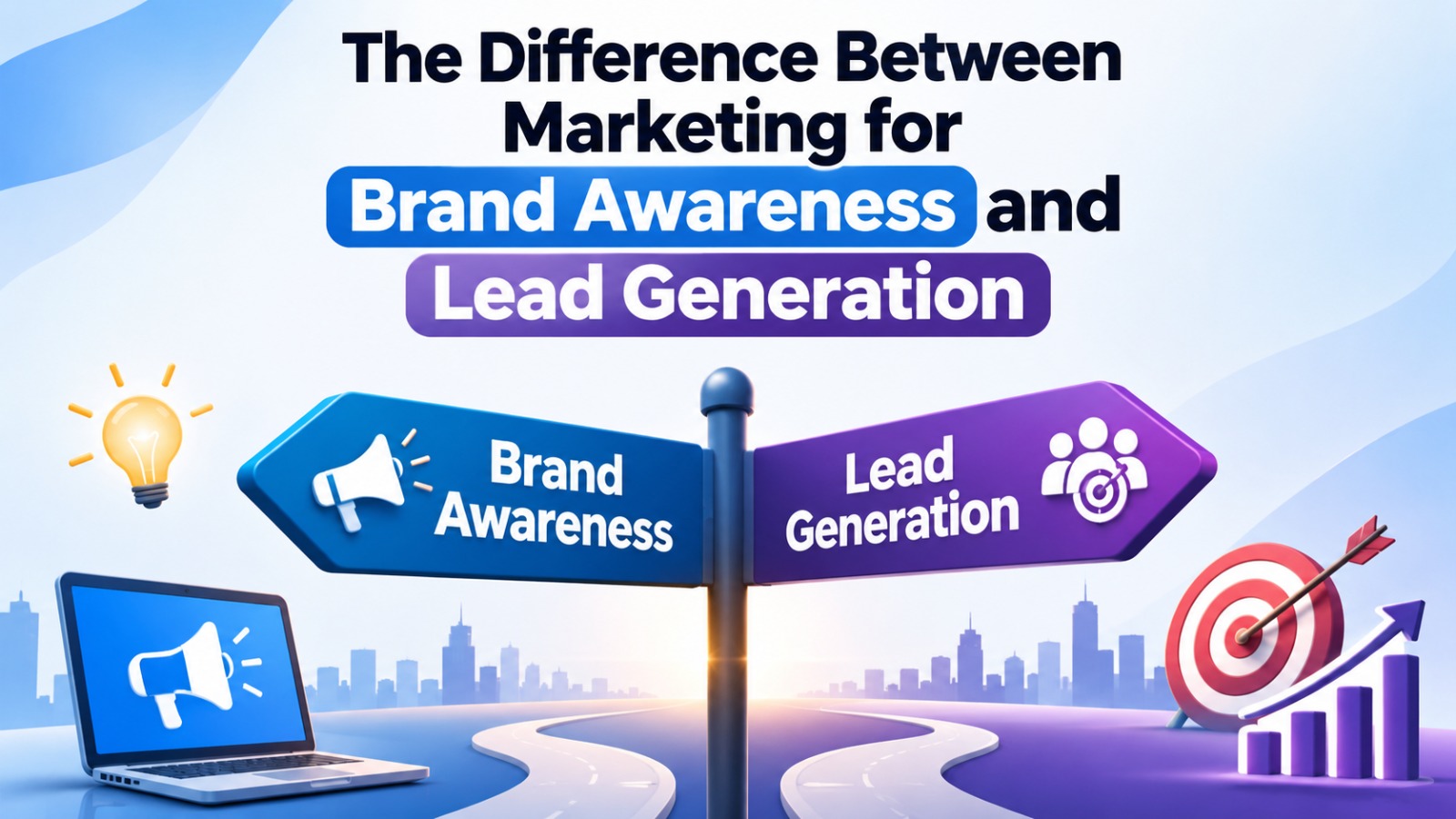
Brand awareness vs lead generation is a crucial decision for UK businesses allocating limited marketing budgets. One approach helps people recognise and remember a company; the other encourages prospective customers to make an enquiry, request a quote or book a consultation. Choosing between them without considering buying behaviour can create expensive gaps in the customer journey.
Quick answer: Brand awareness marketing increases familiarity, credibility and future demand, while lead generation marketing captures interest from people ready to take a measurable action. Most businesses need both: awareness creates a stronger pool of potential buyers, and lead generation converts that interest into qualified opportunities. The right balance depends on sales cycles, budget, and business goals.
Brand Awareness vs Lead Generation: The Core Difference
Brand awareness aims to make a business known and trusted among its intended audience. Lead generation aims to identify prospective buyers and encourage a specific response. They are complementary objectives, not competing channels: the same search advert, article or social campaign can contribute to both, but its primary purpose determines how it should be designed and measured.
For example, a Manchester accountancy practice might publish guidance on Making Tax Digital to build credibility with local businesses. A separate landing page offering an initial consultation could then capture enquiries from directors actively looking for support.
What Brand Awareness Marketing Actually Does
Brand awareness marketing increases the likelihood that customers recognise a name, understand its offer and recall it when a need arises. This matters when buyers research multiple suppliers, seek recommendations or delay purchasing until a contract renewal or life event.
Common brand awareness activities
- Educational articles answering early-stage customer questions
- Organic social content showing expertise, people and values
- Video explainers, webinars and useful industry commentary
- Digital PR and relevant industry partnerships
- Consistent search visibility for non-branded topics
For a Birmingham construction company, a series of practical guides about commercial refurbishment can build familiarity among facilities managers before they issue a tender. The immediate outcome may be engagement rather than a quotation request, but the content supports later consideration.
How to measure awareness without confusing it with sales
Track relevant reach, branded search trends, engaged visits, returning visitors and direct traffic alongside qualitative feedback. These are indicators rather than proof that a campaign caused revenue. Segment by geography and audience; high reach outside the service area can make a campaign look stronger than it is.
What Lead Generation Marketing Actually Does
Lead generation marketing is designed to move an interested person towards an identifiable action. Examples include submitting an enquiry form, calling a business, requesting a demonstration or booking an appointment. A lead is not automatically a sale: the business must assess fit, urgency and potential value.
Common lead generation activities
- Search advertising focused on high-intent service queries
- Dedicated landing pages with a clear proposition and call to action
- Local SEO pages for service areas and locations
- Remarketing to relevant visitors where consent and platform rules permit
- Email follow-up to opted-in contacts and CRM-based nurturing
A Leeds dental clinic might use a location-specific service page for dental implants and offer a consultation booking. A SaaS provider might invite procurement teams to request a tailored product demonstration. Both need clear qualification and timely follow-up.
The metrics that matter for lead generation
Measure qualified leads, cost per qualified lead, enquiry-to-appointment rate, sales acceptance rate and revenue from won customers. Form submissions alone are insufficient: duplicate requests, spam and poorly matched prospects can inflate reported success.
Comparison: Which Objective Should You Prioritise?
| Decision factor | Brand awareness | Lead generation |
| Primary aim | Recognition and trust | Qualified enquiries |
| Audience | People who may buy later | People showing buying intent |
| Typical CTA | Read, watch, explore | Enquire, book, request quote |
| Useful KPIs | Relevant reach, branded searches, engagement | Qualified leads, conversion rate, cost per lead |
| Time horizon | Often longer-term | Often shorter-term, depending on sales cycle |
| Main risk | Attention without commercial relevance | Leads without trust or quality |
The practical answer to brand awareness vs lead generation is rarely an absolute choice. A new entrant may need visibility before conversion activity can scale, while an established provider with strong recognition may benefit more immediately from improving its enquiry journey.
How to Allocate Your Marketing Budget
Start with the business constraint, not a fixed percentage. If the sales team lacks enough suitable enquiries, investigate high-intent search demand, landing page conversion and lead handling. If prospects regularly say they have never heard of the business, or sales cycles are long, sustained awareness activity may be essential.
A practical five-step planning process
- Define the commercial outcome: for example, booked consultations or sales-qualified opportunities.
- Map customer questions from first discovery through supplier comparison and purchase.
- Audit current traffic, branded demand, enquiry quality and follow-up speed.
- Choose a small set of channels that match buying intent and available resources.
- Review performance monthly, then adjust spend based on lead quality and pipeline evidence.
A Liverpool recruitment agency seeking urgent employer briefs may prioritise service-led search campaigns and conversion-focused pages. At the same time, specialist salary insights can make the agency more memorable to hiring managers who are not recruiting yet.
How SEO, PPC and Content Work Together
SEO can support both objectives. Informational pages answer questions and demonstrate expertise, while service pages target searches with clearer purchase intent. Paid search can capture immediate demand; well-targeted paid social and video can introduce the brand to new audiences. Content connects the stages with consistent messages and useful proof.
A Bristol manufacturing supplier could publish an explainer about material specifications, link it to a detailed capability page and provide a straightforward request-for-quotation form. This sequence helps visitors progress without forcing a sales conversation too early.
BVS Digital brings these disciplines together through a joined-up approach to digital strategy. Explore the agency’s services and approach at https://bvsdigital.co.uk/ and discuss your specific objectives via https://bvsdigital.co.uk/contact-us/.
Build a Journey from Recognition to Enquiry
A connected campaign should provide a logical next step at every stage. Early-stage visitors may benefit from a guide or comparison; mid-stage visitors need service details, relevant examples and credible reassurance; ready-to-buy visitors need simple contact options and clear expectations.
Example: an estate agency serving Sheffield
An estate agency could create useful local selling guides to establish authority, publish service pages explaining valuation and marketing packages, and make booking a valuation straightforward. Reporting should connect landing pages and campaign sources to completed appointments, not simply count guide downloads.
Example: a professional services firm in London
A consultancy with a lengthy buying cycle could use research-led articles and webinars to reach decision-makers, then offer a consultation once buyers understand the service. CRM records should capture how enquiries progress so the team can judge whether early-stage activity contributes to real opportunities.
Conversion Tracking and UK Data Protection
Agree what counts as a conversion before launching campaigns. Track calls, forms and bookings accurately, use sensible attribution windows, and connect marketing records to sales outcomes where possible. Audit tracking regularly after website changes; a broken form event can distort budget decisions.
For UK organisations, marketing measurement must also respect privacy requirements. Review the ICO’s guidance on cookies and similar technologies at https://ico.org.uk/for-organisations/direct-marketing-and-privacy-and-electronic-communications/ and ensure consent and communications practices fit the methods used. Google’s Search Central documentation at https://developers.google.com/search/docs provides useful guidance on creating discoverable, helpful website content.
Common Mistakes That Waste Marketing Spend
- Treating impressions as evidence of commercial success without checking audience relevance.
- Expecting every educational post to produce immediate enquiries.
- Optimising adverts for cheap form fills rather than suitable customers.
- Sending every visitor to the homepage instead of a relevant service page.
- Running separate brand and lead campaigns with inconsistent messages.
- Ignoring call handling, response times and CRM feedback after a lead arrives.
The remedy is a shared measurement framework. Marketing, sales and leadership should agree on audience fit, conversion definitions and the point at which an enquiry becomes a qualified opportunity.
When to Focus on Awareness, Leads or Both
Prioritise awareness when entering a new market, launching an unfamiliar service or selling a high-consideration product. Prioritise lead generation when search demand exists, the offer is established and the business can respond promptly. Combine both when competition is strong, customers compare suppliers or revenue depends on a consistent pipeline over time.
For multi-location firms across Glasgow, Manchester and London, local relevance matters. Awareness content can establish a coherent national brand, while tailored location pages and local campaigns address the needs of people searching for a provider in a particular area.
How BVS Digital Can Help Your Business Grow
BVS Digital can help UK businesses connect audience research, search visibility, paid campaigns, website journeys and conversion measurement into one coherent plan. Rather than judging activity by isolated vanity metrics, the aim is to identify which work creates meaningful demand and which turns that demand into qualified conversations.
If you are weighing brand awareness vs lead generation and need a clearer route from marketing spend to enquiries, contact BVS Digital at to discuss your goals, current performance and next steps.
Conclusion: Turn Visibility into Sustainable Demand
The difference between brand awareness vs lead generation is purpose: one helps customers know and trust your business; the other makes it easier for interested buyers to act. Sustainable marketing connects the two, measures the right outcomes and improves the experience from first impression to sales conversation. The best investment is the one aligned with your market, sales process and growth priorities.
Frequently Asked Questions
Is brand awareness more important than lead generation?
Neither is universally more important. Businesses with low recognition may need to build trust first, while firms with established demand may benefit from stronger conversion campaigns. Review the sales cycle and the quality of existing enquiries.
Can SEO generate leads and build brand awareness?
Yes. Helpful informational content can introduce a business to prospective customers, while service and location pages can attract people actively comparing suppliers. Both need clear navigation and relevant calls to action.
How long does brand awareness marketing take to work?
Results depend on the market, channel, budget and starting visibility. Look for improving recognition and relevant engagement over time rather than promising a fixed number of weeks. Evaluate leads and sales over an appropriate buying cycle.
What is a good cost per lead for a UK business?
There is no universal benchmark. A worthwhile cost depends on customer value, conversion rates, margins and lead quality. Calculate cost per qualified opportunity and customer acquisition cost rather than relying on raw lead volume.