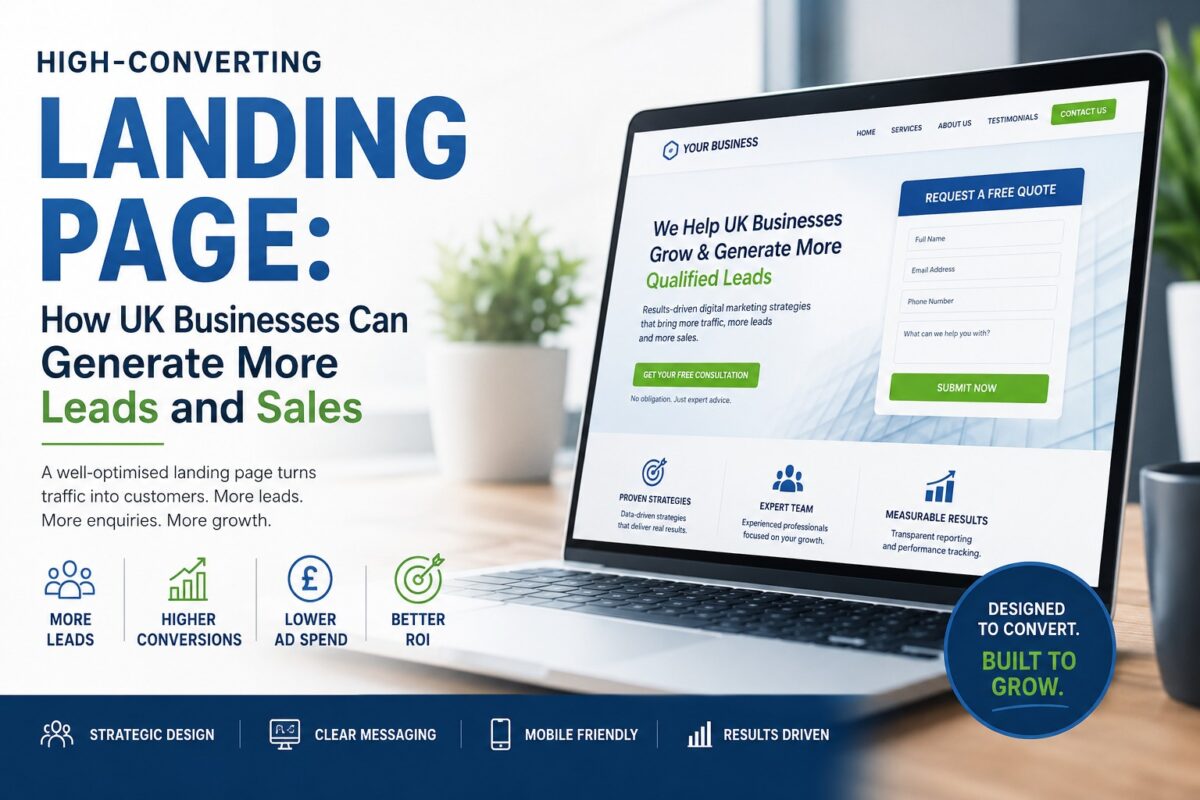
Creating a High-Converting Landing Page is one of the most effective ways for UK businesses to generate leads, increase enquiries, and improve digital marketing ROI. Whether you run a law firm in Manchester, an e-commerce brand in London, or a dental clinic in Birmingham, your landing page plays a critical role in converting traffic into customers.
Many businesses invest heavily in SEO, PPC, and social media campaigns but lose potential customers because their landing pages fail to persuade visitors to take action. A poorly structured page can result in high bounce rates, wasted ad spend, and missed sales opportunities.
In this guide, we explain how to create a landing page designed to convert — using proven conversion rate optimisation strategies tailored for UK businesses.
What Is a High-Converting Landing Page?
A High-Converting Landing Page is a standalone web page specifically designed to encourage users to complete a desired action. This action could include:
- Submitting an enquiry form
- Booking a consultation
- Requesting a quote
- Downloading a brochure
- Making a purchase
- Calling your business
Unlike standard website pages, landing pages are built around a single conversion goal. They remove distractions and guide users towards one clear action.
Businesses in competitive sectors such as healthcare, property, legal services, and construction often rely on landing pages to improve lead quality and reduce acquisition costs.
Why Landing Pages Matter for UK Businesses
Consumer expectations are higher than ever. UK customers expect fast-loading, trustworthy, and easy-to-use websites. If your landing page does not instantly communicate value, users will leave and choose a competitor instead.
A properly optimised High-Converting Landing Page can help businesses:
- Increase conversion rates
- Reduce PPC advertising costs
- Improve lead quality
- Generate more enquiries
- Increase online sales
- Support SEO and paid campaigns
For example, a London estate agency running Google Ads for property valuations may send users to a dedicated landing page with a valuation request form instead of the homepage. This focused experience typically delivers significantly higher conversion rates.
Start with a Clear Value Proposition
Your headline is often the first thing visitors see. It must immediately explain:
- What you offer
- Who it is for
- Why it matters
Weak messaging creates confusion. Strong messaging improves engagement and trust.
Example for a Dental Clinic
Weak: “Welcome to Our Clinic”
Strong: “Affordable Invisalign Treatment for Patients Across Birmingham”
The second example is specific, benefit-driven, and aligned with commercial search intent.
Businesses should ensure the main headline includes the High-Converting Landing Page focus keyword naturally where appropriate for SEO value.
Keep the Design Simple and Focused
One of the biggest conversion mistakes businesses make is overcomplicating their landing pages.
High-performing landing pages prioritise clarity and usability. Visitors should immediately understand:
- What the business offers
- Why they should trust the business
- What action to take next
Key design recommendations include:
- Minimal navigation
- Clear call-to-action buttons
- Mobile-friendly layouts
- Fast page loading speeds
- Readable typography
- Strategic use of white space
For businesses investing in professional website design, working with an experienced digital marketing agency can significantly improve performance outcomes.
Use Strong Call-to-Actions
Your CTA is the conversion trigger. Weak or generic CTAs reduce engagement.
Effective CTA examples include:
- Book Your Free Consultation
- Request a Free Quote
- Get Your Marketing Audit
- Speak to an Expert Today
- Start Your Free Assessment
High-converting landing pages often repeat CTAs throughout the page to capture users at different decision stages.
For example, a recruitment agency in Leeds may use:
“Request Qualified Candidate Shortlists Today”
This is more persuasive than a vague “Submit” button.
Build Trust with Social Proof
Trust is essential for conversions, particularly in industries involving high-value services.
Your High-Converting Landing Page should include trust-building elements such as:
- Google reviews
- Testimonials
- Industry accreditations
- Case studies
- Client logos
- Awards and certifications
A financial services company in Glasgow, for example, may improve conversions by displaying FCA-related trust indicators and client testimonials prominently on the page.
Professional service businesses often underestimate how important credibility signals are in the decision-making process.
Optimise Landing Pages for Mobile Users
Mobile traffic dominates most UK industries, including hospitality, healthcare, and home services.
If your landing page performs poorly on mobile devices, conversion rates will suffer.
Mobile optimisation best practices include:
- Responsive design
- Click-to-call buttons
- Fast loading images
- Short forms
- Easy navigation
- Readable font sizes
For example, emergency trades businesses often receive most enquiries through mobile search. A plumber or electrician with a mobile-friendly landing page can dramatically increase call enquiries from local customers.
Create Industry-Specific Landing Pages
Generic pages rarely convert as effectively as targeted pages.
Businesses should create dedicated landing pages for different industries, services, and locations.
Examples:
- SEO Services for Law Firms
- PPC Campaigns for Dental Clinics
- Website Design for Construction Companies
- Social Media Marketing for Restaurants
- Lead Generation for Estate Agents
This strategy improves:
- Relevance
- Quality Scores in Google Ads
- SEO visibility
- Conversion rates
Businesses looking to improve conversion-focused strategy can explore tailored support through BVS Digital’s consultation services.
Reduce Form Friction
Long or complicated forms reduce conversion rates.
Ask only for information genuinely required at the enquiry stage.
Recommended form fields:
- Name
- Phone Number
- Brief Message
Additional fields can often be collected later during the sales process.
E-commerce businesses, healthcare providers, and service companies all benefit from simplified enquiry forms.
Improve Speed and Technical Performance
Page speed directly affects user experience and conversions.
Slow-loading pages increase abandonment rates and can negatively impact both SEO and paid advertising performance.
Common optimisation techniques include:
- Compressing images
- Reducing unnecessary scripts
- Using reliable hosting
- Implementing caching
- Optimising Core Web Vitals
Businesses investing in digital growth strategies should view technical performance as part of their conversion optimisation process.
Use SEO and PPC Together
A successful High-Converting Landing Page supports both organic and paid traffic strategies.
SEO helps businesses attract long-term search visibility, while PPC drives immediate targeted traffic.
For example:
- A Manchester solicitor may rank organically for legal services while also running PPC campaigns for urgent enquiries.
- An e-commerce retailer may target seasonal product searches using dedicated landing pages.
- A beauty clinic may run location-based PPC campaigns linked to service-specific pages.
The landing page acts as the conversion bridge between traffic acquisition and lead generation.
Track and Continuously Improve Performance
Landing page optimisation is not a one-time process.
Businesses should continuously monitor:
- Conversion rates
- Bounce rates
- Form submissions
- Call tracking
- Scroll depth
- User behaviour
A/B testing can help identify:
- Better headlines
- More effective CTA wording
- Higher-performing layouts
- Improved form designs
Small adjustments often lead to significant conversion improvements over time.
How BVS Digital Helps Businesses Improve Conversions
At BVS Digital, we help UK businesses create conversion-focused digital experiences that generate measurable commercial results.
Our team supports businesses across industries including:
- Professional services
- Healthcare
- Construction
- E-commerce
- Hospitality
- Real estate
- Automotive
- Education
Our services include:
- Landing page design
- Conversion rate optimisation
- PPC management
- SEO strategy
- Technical performance optimisation
- User experience improvements
If your current website traffic is not converting effectively, investing in a professionally developed High-Converting Landing Page could significantly improve your lead generation performance.
Conclusion
A High-Converting Landing Page is one of the most valuable assets in modern digital marketing. It helps businesses maximise traffic value, improve lead quality, and increase sales opportunities.
Whether you operate a legal practice in London, a healthcare clinic in Birmingham, or an e-commerce business serving customers across the UK, conversion-focused landing pages can directly impact revenue growth.
Businesses that combine strategic messaging, strong design, technical optimisation, and persuasive calls-to-action are far more likely to outperform competitors online.
To improve your website conversions and generate more qualified leads, partnering with an experienced digital marketing agency can provide a major competitive advantage.
Frequently Asked Questions
What makes a High-Converting Landing Page effective?
An effective landing page combines clear messaging, strong CTAs, fast loading speeds, trust signals, and a focused user journey designed to encourage conversions.
How many landing pages should a business have?
Most businesses benefit from multiple landing pages targeting different services, industries, locations, or advertising campaigns to improve relevance and conversion rates.
Can landing pages improve Google Ads performance?
Yes. Well-optimised landing pages can improve Quality Scores, reduce cost-per-click, and increase conversion rates for PPC campaigns.
Should landing pages be optimised for SEO?
Absolutely. SEO-friendly landing pages can attract organic traffic while also supporting paid advertising campaigns and lead generation strategies.