
A website for a Leeds accountancy practice has very different requirements from a nationwide manufacturer with a complex product configuration tool. Choosing the same development approach for both could leave one business paying for unnecessary functionality and the other struggling with technical limitations.
The decision between WordPress vs custom website development should begin with your commercial objectives, not the technology itself. Whether you need more qualified enquiries, online sales or a better customer experience, the right platform should support those goals without creating avoidable operational costs.
Which website development approach is better?
WordPress is generally the better choice for UK businesses that need an affordable, editable and search-friendly marketing website. Custom website development suits organisations with complex integrations, unique customer journeys or specialist software requirements. The best option depends on your budget, internal resources, functionality and long-term plans for growth.
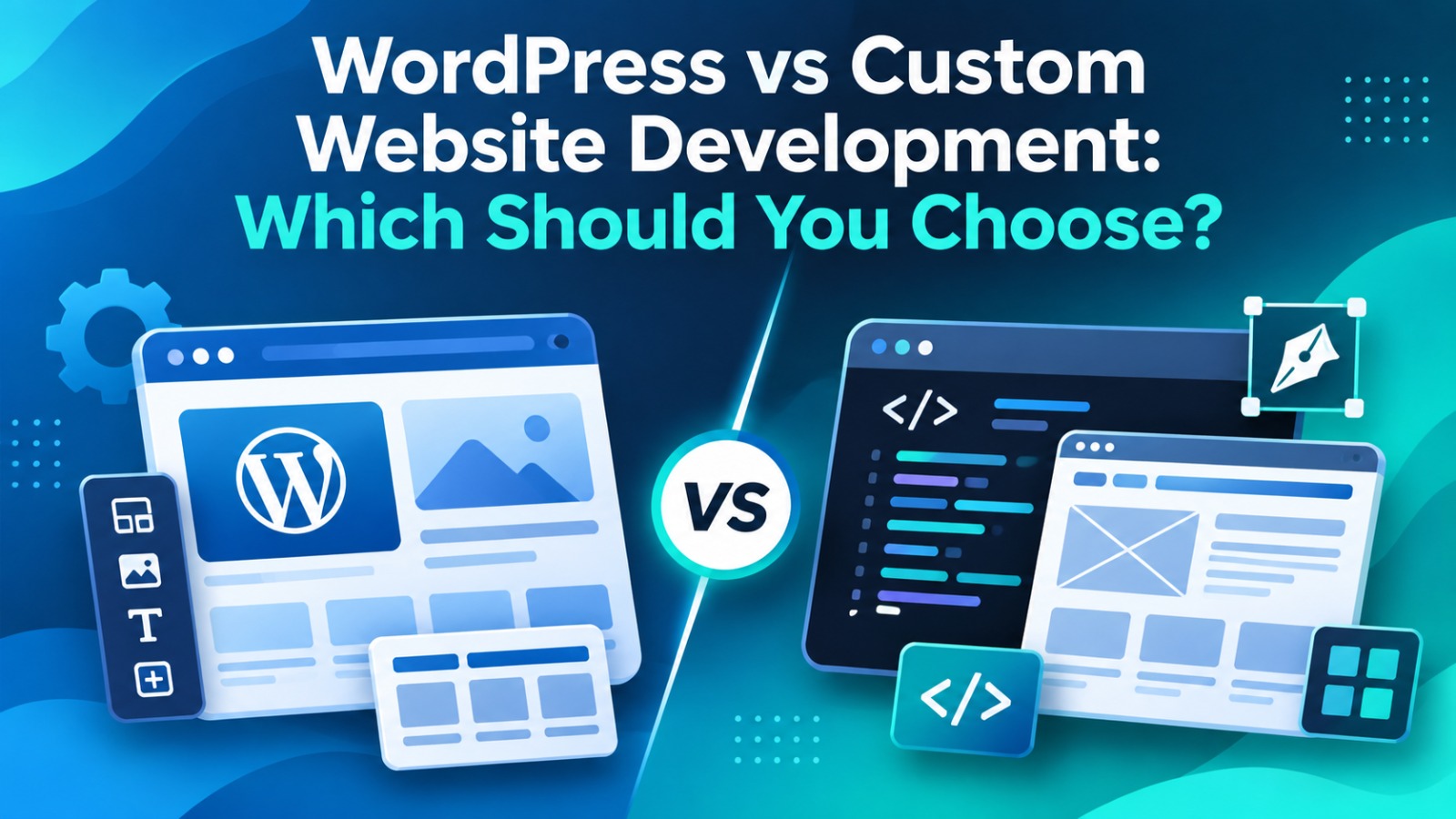
WordPress vs custom website development: the main differences
WordPress is an open-source content management system (CMS). It provides an established framework for publishing pages, managing media and adding functionality through plugins. A professionally developed WordPress site can use a bespoke visual design rather than an off-the-shelf template.
A custom-built website uses a tailored architecture selected for the project. Developers may use established frameworks, libraries and a separate CMS rather than writing every component from scratch. This gives the development team greater control over how data, interfaces and business processes interact.
The distinction is therefore not simply template versus bespoke design. Both approaches can deliver a distinctive brand experience. The more important question is whether your requirements benefit from an established publishing platform or demand a different technical foundation.
| Factor | WordPress | Custom development |
| Initial investment | Often lower for standard needs | Usually higher for specialist features |
| Content editing | Established CMS | Depends on CMS selected |
| Integrations | Plugins and custom modules | Tailored to requirements |
| Maintenance | Core and extension updates | Code and dependency updates |
| Best fit | Marketing sites and standard shops | Specialist workflows and applications |
When should UK businesses choose WordPress?
Lead generation and professional services
For a London law firm or a Manchester accountancy practice, a website typically needs service pages, practitioner profiles, useful articles and clear enquiry routes. WordPress development can support these requirements while allowing authorised staff to publish updates without requesting code changes.
A well-planned site can also use structured content for offices and services. This allows a multi-location business to maintain consistent contact details and navigation while providing useful information for each location. Avoid producing near-identical location pages solely to target search terms.
Retail and routine online sales
A small retailer can use WordPress with WooCommerce to manage products, orders and promotions. This can be appropriate when payment, stock management and delivery requirements fit supported extensions. Check compatibility with existing accounting and fulfilment systems before committing to the platform.
For these businesses, the WordPress vs custom website development decision often comes down to how much functionality is already available. Investing the remaining budget in product photography, persuasive copy and customer acquisition may deliver more value than recreating standard features.
Content-led growth
WordPress is particularly useful when marketing teams publish regularly. A construction company in Birmingham might add project galleries, service guides and tender-related information as its portfolio grows. A reusable page structure helps maintain consistency without restricting the editorial team.
Explore BVS Digital’s web design and development services for an approach that connects design, content, usability and search performance from the planning stage.
When is custom website development worth the investment?
Complex business processes and integrations
A manufacturer may need a quotation system that calculates prices from material specifications, production capacity and delivery schedules. A custom solution could connect these processes with an enterprise resource planning system and provide different permissions for customers, distributors and employees.
The value comes from reducing manual work, preventing avoidable errors and making it easier for customers to complete an order. Before commissioning the build, quantify the existing workload and identify the processes that genuinely need automation.
Specialist customer experiences
A recruitment business might require a candidate portal with advanced matching, role-specific dashboards and integrations with an applicant tracking system. A generic plugin may cover some requirements but fail to support the complete workflow.
In this situation, WordPress vs custom website development becomes a question of operational fit. Compare the cost of adapting existing software against the cost of building and maintaining specialist features. A hybrid architecture may also be suitable, with WordPress handling marketing content and a separate application managing authenticated users.
How much does a business website cost in the UK?
Comparing website development costs requires more than looking at the initial proposal. WordPress can reduce development effort where standard publishing features meet your needs. Custom development typically involves more discovery, engineering and testing, particularly when several systems must communicate reliably.
Ask agencies to provide a comparable scope and show whether VAT is included. Review hosting, annual licences, content migration, accessibility testing, maintenance, integration fees and future development separately. A lower initial quote may become expensive if important work is excluded.
For a fair WordPress vs custom website development comparison, estimate total ownership costs over three years. Include the internal time your team spends maintaining content and managing enquiries. Also consider the commercial cost of downtime or a prolonged delay when launching new services.
Which approach is better for SEO and conversions?
Neither platform automatically ranks higher on Google. Search visibility depends on useful content, accessible pages, sensible site architecture and technical implementation. WordPress offers convenient SEO tools, while a custom website can give developers more direct control over rendering, resource loading and URL behaviour.
Follow Google’s SEO Starter Guide when planning navigation, page titles and indexing. Ensure important content is available to search engines, particularly if a custom website relies extensively on JavaScript.
For both platforms, test mobile performance, image sizes, page stability and key customer journeys. A dentist in Bristol, for example, should make treatment information, appointment requests and contact details easy to reach on a phone. Measure completed appointment requests rather than assuming faster pages alone will increase bookings.
Our search engine optimisation services can help align technical improvements with the searches and enquiries that matter to your business. When comparing WordPress vs custom website development, make sure the proposal includes an SEO migration plan if you already have established rankings.
Security, accessibility and ongoing website maintenance
WordPress requires regular core, theme and plugin updates, reliable backups and controlled administrator access. Choose maintained extensions and remove unnecessary plugins. Test significant updates in a staging environment before applying them to a live site.
Custom development also requires security updates, dependency monitoring, testing and a documented recovery process. Bespoke code does not become secure simply because it is less widely used. Agree who is responsible for security incidents and how quickly critical issues will be addressed.
UK businesses collecting personal information should consider data minimisation, appropriate security and applicable privacy requirements. The ICO’s UK GDPR guidance is a useful starting point. Both platforms should also be tested for keyboard navigation, readable contrast, accessible forms and meaningful image descriptions.
How to make the right decision for your business
Use the following steps before approving a WordPress vs custom website development proposal.
- Define the primary business outcome, such as qualified enquiries, completed purchases or reduced administrative work.
- Document essential features separately from optional enhancements and identify the systems that must integrate with the site.
- Ask how staff will edit content, manage permissions and access customer information after launch.
- Request a demonstration or prototype of the most complex workflow before agreeing to a full build.
- Agree on ownership of the domain, hosting accounts, code, content and data export arrangements.
- Set acceptance criteria for mobile usability, accessibility, enquiry tracking, security and launch readiness.
These steps help prevent common mistakes, including choosing a platform solely on price, installing excessive plugins or commissioning bespoke features that customers will rarely use. They also make it easier to compare agency proposals on equivalent terms.
Why choose BVS Digital for your website project?
At BVS Digital, we approach website projects through business objectives, customer needs and digital marketing requirements. Our London-based team supports UK businesses with website planning, responsive design, development, SEO and conversion-focused improvements.
Our published Technical Detail website development project illustrates how responsive layouts, content structure and performance considerations can be combined within a website build. The right technical solution for your own business will depend on your requirements rather than a predetermined platform.
We work through discovery, design, development and launch, with ongoing support agreed according to the project scope. This helps ensure that your website remains manageable as your services, customers and marketing priorities evolve.
Conclusion
The WordPress vs custom website development decision should reflect the work your website needs to perform. WordPress is often a practical starting point for marketing-led SMEs, while bespoke development can justify its additional investment when specialist workflows or integrations create genuine commercial value. A hybrid solution may offer a useful balance.
Still weighing WordPress vs custom website development? If your existing website restricts growth or you are unsure how to invest in a new one, contact BVS Digital to discuss your requirements and identify a development approach aligned with your budget and business goals.
Frequently Asked Questions
Is WordPress suitable for a large business website?
Yes. WordPress can support large content-rich websites when hosting, architecture, caching and editorial permissions are planned carefully. Complex transactional workloads may require dedicated services or a different architecture. Assess expected traffic and operational requirements rather than company size alone.
Is a custom website more expensive than WordPress in the UK?
Often, yes, because bespoke functionality requires additional planning, coding and testing. However, a complex WordPress build can also be costly. Compare equivalent features, support arrangements and ownership costs rather than relying on platform-based price estimates.
Can I move from WordPress to a custom website later?
Yes. Plan the migration around content exports, media, URL mapping, redirects, integrations and analytics continuity. Preserving valuable content and testing the new site before launch can reduce disruption to organic visibility and customer journeys.
Do I need a developer to update a custom website?
Not necessarily. A custom website can include a user-friendly CMS for routine content changes. Structural changes, integrations and new functionality may still require developer involvement. Ask for an editing demonstration and handover training before choosing your supplier.