
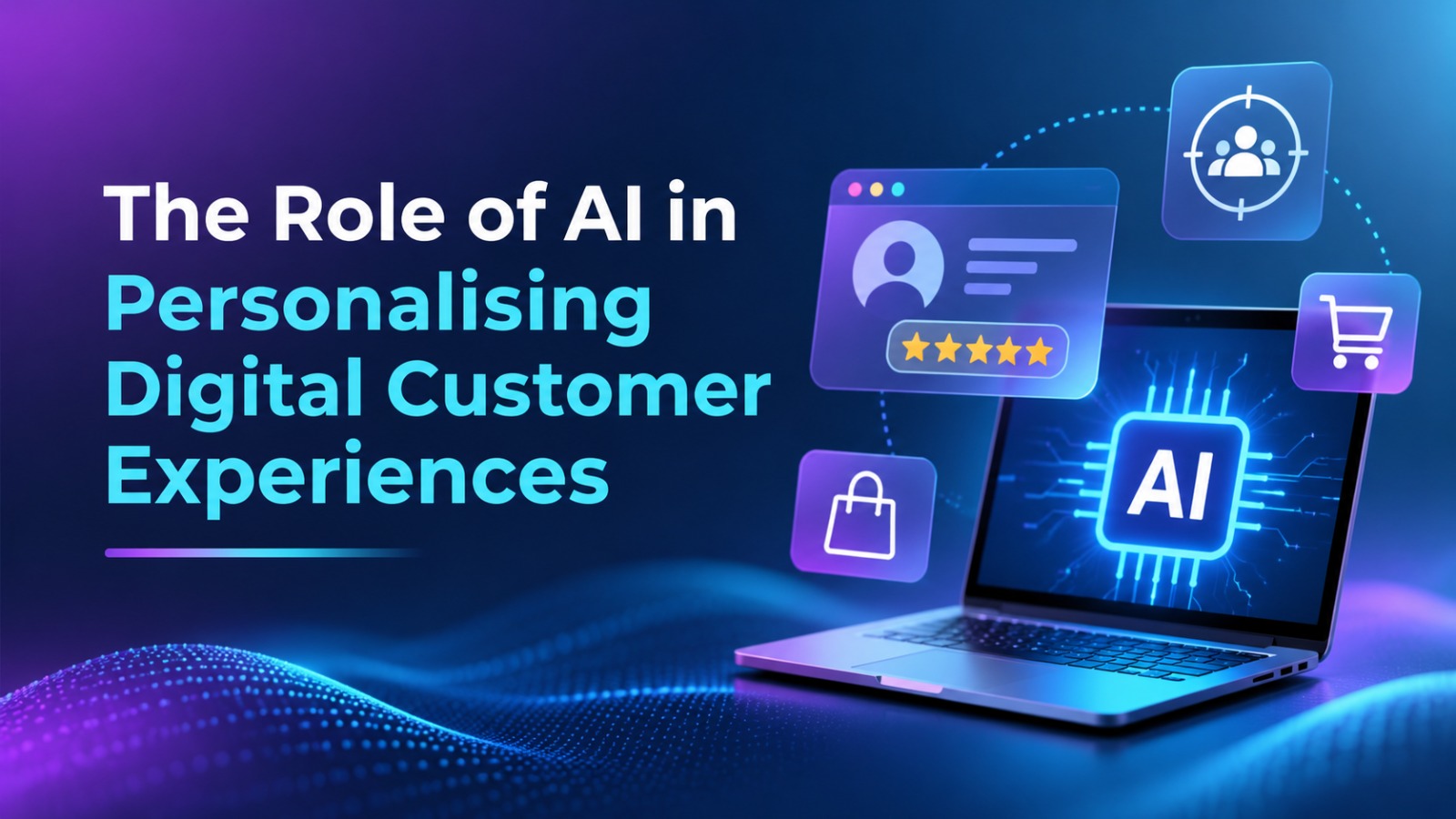
A customer who has already compared your services should not have to start from scratch on every visit. Yet many UK websites show identical messages to first-time visitors, returning prospects and existing clients. AI customer experience personalisation helps businesses respond to those different needs without manually creating a separate journey for every individual.
For an estate agent, that might mean showing relevant property guides. For a retailer, it could mean recommending complementary products. For a professional services firm, it may mean presenting the most useful next step based on the page someone has visited.
Featured snippet: What is the role of AI in personalising digital customer experiences?
AI analyses permitted customer signals, such as browsing behaviour, previous purchases and stated preferences, to help businesses deliver more relevant content, recommendations and communications. Used carefully, AI customer experience personalisation can reduce friction, improve customer satisfaction and support conversions. It works best with accurate data, transparent consent practices and ongoing human oversight.
Why AI customer experience personalisation matters to UK businesses
People expect digital services to recognise their intentions, but they also want control over their information. Generic campaigns can waste budget by repeating irrelevant offers. Better targeting makes it easier for customers to find suitable products, book consultations or request quotes.
The commercial opportunity is not simply to address people by their first name. It is to understand which information would help them make a decision at a particular moment. That could mean highlighting delivery information for an online shopper or explaining finance options to a customer considering a high-value purchase.
For SMEs in Manchester, Birmingham, Leeds or London, the starting point does not need to be an expensive technology stack. A focused improvement to one customer journey can be more valuable than launching personalisation across every channel at once.
How AI makes customer journeys more relevant
1. Behaviour-based content recommendations
AI tools can identify patterns in the content visitors engage with and recommend related information. A construction company might show commercial refurbishment case-study categories to someone browsing office fit-out pages, while directing homeowners towards domestic renovation guidance.
Recommendations should help users rather than trap them in a narrow set of assumptions. Keep navigation accessible and allow visitors to choose another route.
2. Smarter customer segmentation
Traditional segmentation groups customers by broad characteristics. AI-assisted segmentation can also consider signals such as recent enquiries, product interest, frequency of visits and engagement history. Teams can then adapt email content or landing-page messages to a clearer need.
For an accountancy practice, a new limited-company founder may need bookkeeping guidance, while an established business may be comparing outsourced finance services. The messages should differ even if both visitors are in the same city.
3. Predictive insights and next-best actions
Predictive models estimate likely outcomes from historical patterns. They can help prioritise follow-ups, suggest useful resources or identify customers who may need additional support. Predictions are not facts, so businesses should test their accuracy and avoid using them as the sole basis for consequential decisions.
4. AI-supported customer service
A well-configured chatbot can answer routine questions about opening hours, appointment availability, delivery policies or service coverage. It should clearly identify when it is automated and provide an easy route to a human for complex or sensitive issues.
Healthcare providers and financial services firms need particular care: automated responses should not substitute for qualified professional advice.
5. More relevant email and advertising
Marketing automation can use consented preferences and engagement to decide which information to send and when. An online retailer could follow up with product-care guidance after a purchase rather than immediately pushing another sale. A B2B consultancy might send a practical checklist after someone requests a guide.
Where UK businesses can apply AI personalisation first
| Business type | Useful application | Meaningful measure |
| E-commerce retailer | Relevant product recommendations and replenishment reminders | Revenue per session and repeat purchase rate |
| Estate agency | Area-specific property content and enquiry follow-up | Qualified viewing enquiries |
| Dentist or clinic | Service-specific FAQs and booking guidance | Completed appointment requests |
| B2B professional services | Industry-specific resources and lead nurturing | Sales-qualified enquiries |
| Hotel or restaurant | Relevant local information and booking prompts | Completed direct bookings |
These are possible applications, not promised results. Each business should confirm that the proposed use fits its audience, operational capacity and lawful basis for processing data.
A practical implementation plan for SMEs
Step 1: Choose one high-friction journey
Review analytics, customer enquiries, search terms and sales conversations. Look for a specific point where visitors struggle, such as finding the right service, understanding pricing or completing an enquiry form. Define the problem before selecting an AI tool.
Step 2: Audit your data and permissions
Map the information collected, where it is stored and which systems can access it. Remove outdated records and avoid collecting information simply because the technology allows it. Check consent requirements for cookies and electronic marketing, and document an appropriate lawful basis for other processing.
The Information Commissioner’s Office provides guidance on data protection and AI at https://ico.org.uk/; its guidance should inform the project from the beginning, not just before launch.
Step 3: Start with a modest pilot
Test one intervention, such as recommendations on a product category page or tailored follow-up content for a defined enquiry type. Establish a control group where feasible. Make sure the non-personalised experience remains useful.
Step 4: Connect marketing and website teams
Personalisation fails when a website displays one promise but the sales team follows a different process. Align website content, CRM fields, email workflows and customer service scripts. Assign responsibility for reviewing recommendations and fixing inaccurate messages.
Step 5: Measure business outcomes
Track outcomes that reflect customer value: qualified enquiries, completed purchases, booking completion, average order value, repeat engagement and complaint rates. Monitor privacy-related opt-outs and the proportion of users who need human assistance.
Compare performance against a baseline and examine differences across devices, traffic sources and customer groups. A higher click-through rate is not automatically evidence of higher revenue or a better experience.
Common mistakes that undermine AI personalisation
- Personalising too early: weak traffic and incomplete data can make automated decisions unreliable.
- Over-collecting information: excessive tracking increases risk without necessarily improving relevance.
- Treating AI output as accurate by default: review generated copy, recommendations and chatbot answers.
- Ignoring accessibility: tailored interfaces still need clear navigation, readable content and usable forms.
- Optimising for clicks alone: assess enquiries, sales quality, retention and customer feedback.
- Using opaque targeting: explain relevant data practices and provide meaningful privacy choices.
Privacy, trust and the UK regulatory context
AI customer experience personalisation should be designed around data minimisation, transparency, security and fairness. Under UK GDPR, organisations need a lawful basis for personal-data processing and must respect applicable rights. PECR rules may also apply to tracking technologies and direct electronic marketing.
Read the ICO’s guidance at https://ico.org.uk/ and the UK Government’s data protection overview at https://www.gov.uk/data-protection. Where automated processing could have significant effects, seek specialist legal or compliance advice and assess whether a data protection impact assessment is required.
Avoid uploading sensitive customer records into an AI service without confirming contractual safeguards, retention settings, access controls and international transfer arrangements. Human review remains essential for higher-risk decisions.
How to choose the right AI personalisation partner
An agency should begin with customer research and commercial objectives, not a software demonstration. Ask how the proposed approach will fit your existing website, CRM and analytics setup. Request a clear measurement plan, realistic implementation stages and documented privacy considerations.
Look for a partner who can coordinate SEO, conversion-focused website improvements, content and paid campaigns. Personalisation is most useful when the underlying customer journey already works. Poorly structured pages and confusing forms cannot be fixed by targeting alone.
BVS Digital approaches digital growth as a connected process: understand demand, improve the experience and measure meaningful outcomes. Businesses can explore the agency’s approach at https://bvsdigital.co.uk/ and discuss their priorities at https://bvsdigital.co.uk/contact-us/.
What a sensible 90-day rollout could look like
During the first 30 days, audit customer journeys, analytics quality, data permissions and opportunities. Agree one primary conversion metric and choose a pilot use case. In days 31-60, build the experience, review content accuracy, test privacy controls and train staff to manage exceptions.
During days 61-90, run a controlled evaluation, compare results with the baseline and collect customer feedback. Expand only where the evidence supports it. This staged approach helps avoid spending on complex automation before proving that it solves a real customer problem.
Conclusion: make relevance useful, measurable and responsible
AI customer experience personalisation can help UK businesses guide customers towards the information and actions they actually need. Its value comes from better journeys, not simply more automation. Start with one clear problem, use trustworthy data, keep people in control and measure commercial outcomes.
If your website attracts visitors but struggles to turn interest into qualified enquiries, BVS Digital can help assess your customer journey and identify practical improvements. Discuss an AI customer experience personalisation strategy tailored to your business at https://bvsdigital.co.uk/contact-us/.
Frequently Asked Questions
Is AI personalisation suitable for small UK businesses?
Yes, when there is a specific customer problem to solve and enough reliable data to test an improvement. Many SMEs should begin with simple recommendations or tailored follow-up messages rather than complex predictive systems.
Does AI website personalisation require cookie consent in the UK?
It depends on the technologies and purposes involved. Non-essential cookies and similar tracking generally require consent under PECR, while personal-data processing also needs a UK GDPR lawful basis. Seek advice for your particular setup.
How much does AI customer experience personalisation cost?
Costs depend on the existing website and CRM, data quality, integration work, licences and ongoing monitoring. A small pilot can establish whether the expected value justifies a broader investment.
How can we tell whether AI personalisation is working?
Compare an agreed baseline or control group with outcomes such as qualified enquiries, purchases, bookings and retention. Review customer feedback, errors and privacy opt-outs alongside conversion metrics.