
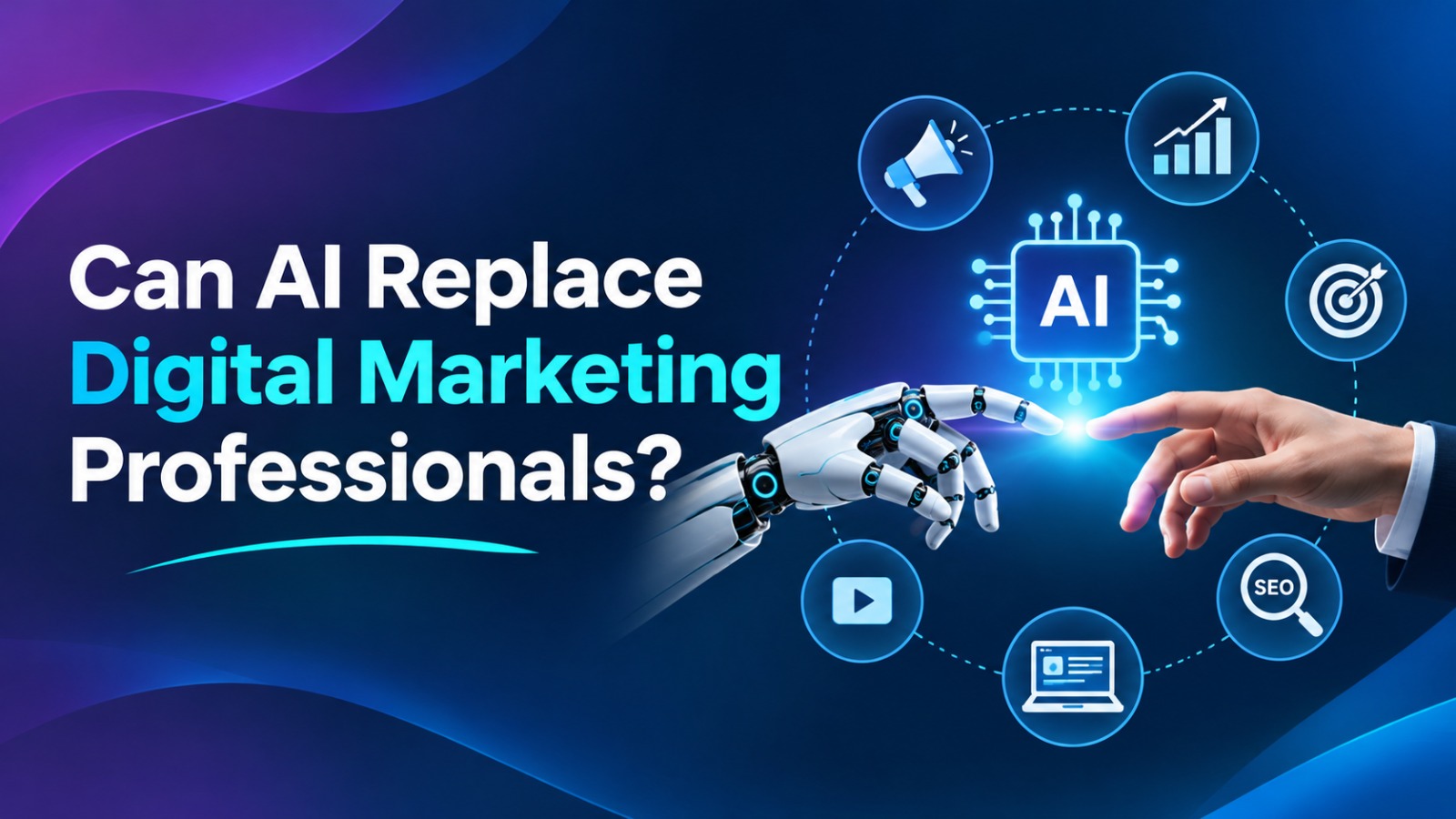
Artificial intelligence can now draft adverts, suggest keywords, generate reports and automate campaign decisions. For UK businesses, the important question is not whether AI can complete marketing tasks. It is whether those tasks add up to a profitable strategy without professional judgement. Understanding the difference can prevent wasted budgets, inconsistent messaging and poor-quality leads.
Can AI replace digital marketing professionals? The short answer
AI can automate many digital marketing tasks, but it cannot reliably replace the commercial judgement, accountability, customer understanding and cross-channel planning provided by experienced professionals. UK businesses generally achieve a stronger approach by combining AI-assisted execution with human-led strategy, creative direction, quality assurance and performance measurement.
Why this question matters to UK businesses
An owner managing a growing dental practice in Birmingham may want more appointments without hiring a large marketing team. A Manchester manufacturer may need qualified B2B enquiries, while a London law firm must communicate carefully about regulated services. All three can use AI, but each needs different positioning, controls and measures of success.
AI makes production cheaper and faster. It also makes it easier to publish generic content, launch poorly configured adverts or misinterpret automated recommendations. The cost of a wrong decision may exceed the time saved by the software.
The real choice is not AI versus people. It is whether your business has the expertise to direct AI towards measurable outcomes.
What AI can already do in digital marketing
Modern tools can support research, content workflows, audience segmentation, reporting and campaign optimisation. Their value depends on the quality of the input data, the clarity of the brief and the review process.
- Draft first versions of blog articles, product descriptions and email campaigns.
- Cluster search queries and suggest content topics for SEO planning.
- Generate alternative advertising copy and creative concepts for testing.
- Summarise analytics dashboards and flag unusual changes in performance.
- Automate bidding, audience signals and routine campaign adjustments within advertising platforms.
- Assist with customer service responses, scheduling and workflow documentation.
These capabilities can free specialists to spend more time on customer research, testing and strategic decisions. They do not guarantee accuracy, compliance or commercial relevance.
Where human digital marketing professionals still add value
1. Turning business objectives into a strategy
A tool can suggest channels, but it cannot independently decide which growth target is commercially sensible for your business. Professionals examine margins, sales capacity, customer lifetime value, seasonality and competition before recommending where to invest.
For example, an estate agency seeking valuation appointments should not judge success by website visits alone. Its strategy needs to prioritise seller enquiries, local trust and the quality of leads entering the sales process.
2. Understanding customers and the local market
AI can identify patterns in available information, but it may miss local nuances, changing customer objections or the realities of a specialist sector. A marketing professional can interview sales teams, review customer feedback and refine messages around genuine buying motivations.
A trades business in Leeds may need emergency enquiries within a defined service radius. A nationwide e-commerce retailer may need profitable repeat purchases. The same automated campaign template will not serve both equally well.
3. Protecting trust, accuracy and brand reputation
AI-generated claims can sound convincing even when unsupported. This is particularly risky for healthcare, financial services and legal businesses, where accuracy and appropriate approvals matter.
Human reviewers should check facts, claims, tone, accessibility, intellectual property considerations and whether the content genuinely helps its intended audience. Publishing quickly is not a substitute for publishing responsibly.
4. Connecting channels and interpreting results
An SEO report may show rising traffic while sales enquiries decline. A PPC dashboard may celebrate cheap conversions that turn out to be irrelevant leads. Professionals investigate the full customer journey rather than treating platform metrics as the final answer.
That requires coordination between SEO, paid advertising, website design, content, CRM processes and conversion rate optimisation. Learn more about the connected approach at BVS Digital
AI versus a digital marketing professional: a practical comparison
| Activity | AI contribution | Human responsibility |
| Keyword research | Groups and expands keyword ideas | Checks intent, competition and commercial value |
| Content production | Creates outlines and drafts | Adds expertise, evidence and editorial approval |
| Paid advertising | Automates bidding and asset testing | Sets goals, budgets, safeguards and lead-quality checks |
| Reporting | Summarises trends and anomalies | Explains causes and chooses corrective action |
| Brand strategy | Produces concepts and variations | Defines differentiation and protects consistency |
| Compliance | Flags potential issues | Confirms requirements with qualified advisers |
Can AI replace digital marketing professionals in SEO?
AI can accelerate keyword clustering, page briefs and technical issue triage. However, effective SEO still requires understanding search intent, evaluating competitors, prioritising technical fixes and creating information that deserves to rank.
Google advises creators to focus on helpful, reliable, people-first content rather than content produced primarily to manipulate search rankings. Its guidance is useful when deciding how AI fits into an editorial workflow: https://developers.google.com/search/docs/fundamentals/creating-helpful-content.
For a solicitor in Liverpool, a generic article about conveyancing may add little value. A carefully reviewed explanation of the firm’s process, service areas and common client questions can better support relevant enquiries.
Can AI manage PPC campaigns without an expert?
Advertising platforms already use machine learning for bidding, targeting and asset delivery. Yet automated systems optimise towards the conversion signals they receive. If tracking counts every low-quality form submission as a success, automation may efficiently pursue the wrong outcome.
A specialist can validate conversion events, exclude unsuitable traffic where controls permit, test landing pages and connect leads to sales outcomes. Google Ads documentation explains how automated bidding uses conversion data: https://support.google.com/google-ads/answer/2979071.
For a recruitment agency, the useful metric may be qualified employer enquiries rather than all contact-form completions. The difference requires human-defined qualification criteria and regular CRM feedback.
What about content creation and social media?
AI is particularly useful for turning a strong brief into draft social captions, article structures and campaign variations. But a stream of polished, interchangeable posts is unlikely to communicate why customers should choose one company over another.
A Bristol restaurant can use AI to draft promotional copy, while staff supply accurate menu information, seasonal photography and the authentic story behind the business. A Glasgow accountancy practice can use AI to organise frequently asked questions, while qualified experts verify technical explanations.
Content needs a distinctive point of view, reliable facts and an editorial process. AI should support those inputs, not invent them.
The hidden risks of relying entirely on AI
- Incorrect information: generated text can include fabricated facts, sources or promises.
- Weak differentiation: generic outputs can make competing brands sound alike.
- Poor measurement: automation can optimise for clicks or low-value leads instead of revenue.
- Privacy concerns: confidential customer data should not be pasted into unapproved tools.
- Unclear ownership: without a responsible person, errors may remain uncorrected.
- Overproduction: publishing more content does not automatically improve visibility or enquiries.
UK businesses should review personal-data handling and marketing technologies against relevant ICO guidance: https://ico.org.uk/for-organisations/uk-gdpr-guidance-and-resources/. For regulated sectors, obtain specialist compliance advice where needed.
A better model: AI-assisted marketing with human oversight
The most practical approach is to give AI repeatable, well-defined tasks while retaining human ownership of strategy and outcomes. That creates efficiencies without surrendering quality control.
- Audit current marketing: identify which channels produce qualified enquiries, customers and revenue.
- Choose a narrow AI use case: start with reporting summaries, content outlines or approved creative variations.
- Set guardrails: define brand voice, factual sources, permissions, review owners and data-handling rules.
- Build an approval workflow: check every customer-facing claim and review significant campaign changes.
- Measure business outcomes: track lead quality, acquisition cost, conversion rate and sales impact.
- Review monthly: compare time saved with quality, performance and operational risks before expanding use.
A construction firm in Sheffield might begin by using AI to organise project FAQs while its team supplies real project details. A multi-location healthcare provider could first automate reporting summaries while retaining clinical review of all service content.
Should you hire an agency, build an internal team or use AI tools?
The right model depends on budget, internal skills and the complexity of your customer journey. AI tools can help a small team move faster, but they do not automatically supply missing expertise.
- AI-first with internal oversight: suitable for limited, low-risk tasks when a knowledgeable employee can review outputs.
- In-house marketing team: useful where day-to-day brand and commercial knowledge is central and specialist capacity exists.
- Agency partnership: useful when the business needs coordinated expertise across SEO, PPC, web design, content and conversion optimisation.
- Hybrid approach: combines internal market knowledge, agency strategy and AI-enabled production for scalable execution.
Before committing, ask who owns strategy, who checks accuracy, how leads are qualified and how campaign decisions connect to revenue. Price comparisons alone rarely answer those questions.
Why work with BVS Digital?
BVS Digital helps UK organisations connect digital strategy with practical execution across search, paid advertising, websites and conversion improvement. Rather than treating AI-generated output as the objective, the focus should remain on attracting relevant audiences and converting interest into meaningful enquiries.
Businesses evaluating professional support can explore BVS Digital’s digital marketing perspective and services through its website, including its guidance on 2026 trends: https://bvsdigital.co.uk/digital-marketing-trends-uk-2026/. The team can help identify where automation supports your goals and where experienced oversight remains essential.
How to choose the right AI-enabled marketing partner
Ask prospective partners to show how they validate AI-assisted work, protect customer data and report outcomes. A credible provider should explain what is automated, what is reviewed by specialists and how recommendations are tested.
Look for clear deliverables, realistic timelines, access to performance data and a plan for improving lead quality. Avoid promises of guaranteed rankings, instant growth or fully autonomous marketing success.
Talk to BVS Digital about your next step
If your business is considering whether AI can replace digital marketing professionals, start by identifying the work that should be automated and the decisions that still need expert attention. BVS Digital can help assess your current approach and develop a commercially focused plan for better visibility, stronger enquiries and measurable growth. Contact the team: https://bvsdigital.co.uk/contact-us/.
Conclusion: Can AI replace digital marketing professionals?
AI will continue to change how marketing work gets done, but replacing tasks is not the same as replacing professional accountability. The strongest approach combines efficient tools with customer insight, sound strategy, accurate content and meaningful measurement.
For UK SMEs and growing brands, the question “can AI replace digital marketing professionals?” is best answered through results: use AI where it adds efficiency, and retain expert oversight wherever decisions affect trust, budgets and revenue.
Frequently Asked Questions
Will AI replace digital marketing jobs in the UK?
AI is likely to reshape responsibilities and automate some routine work. Roles requiring strategy, creative judgement, client relationships, analysis and accountability will still need human expertise.
Is AI marketing cheaper than hiring an agency?
AI subscriptions may reduce production costs, but businesses must also account for setup, checking, compliance, wasted advertising spend and internal management time. Compare total cost against qualified leads and revenue.
Can ChatGPT do SEO for my business?
ChatGPT can help brainstorm topics, organise keyword ideas and draft content. It cannot guarantee rankings or replace technical audits, competitor analysis, editorial verification and ongoing performance management.
How should a small UK business start using AI in marketing?
Choose one low-risk workflow, document approval rules, avoid sharing sensitive data without proper safeguards, and track whether the change saves time while maintaining content quality and lead performance.