
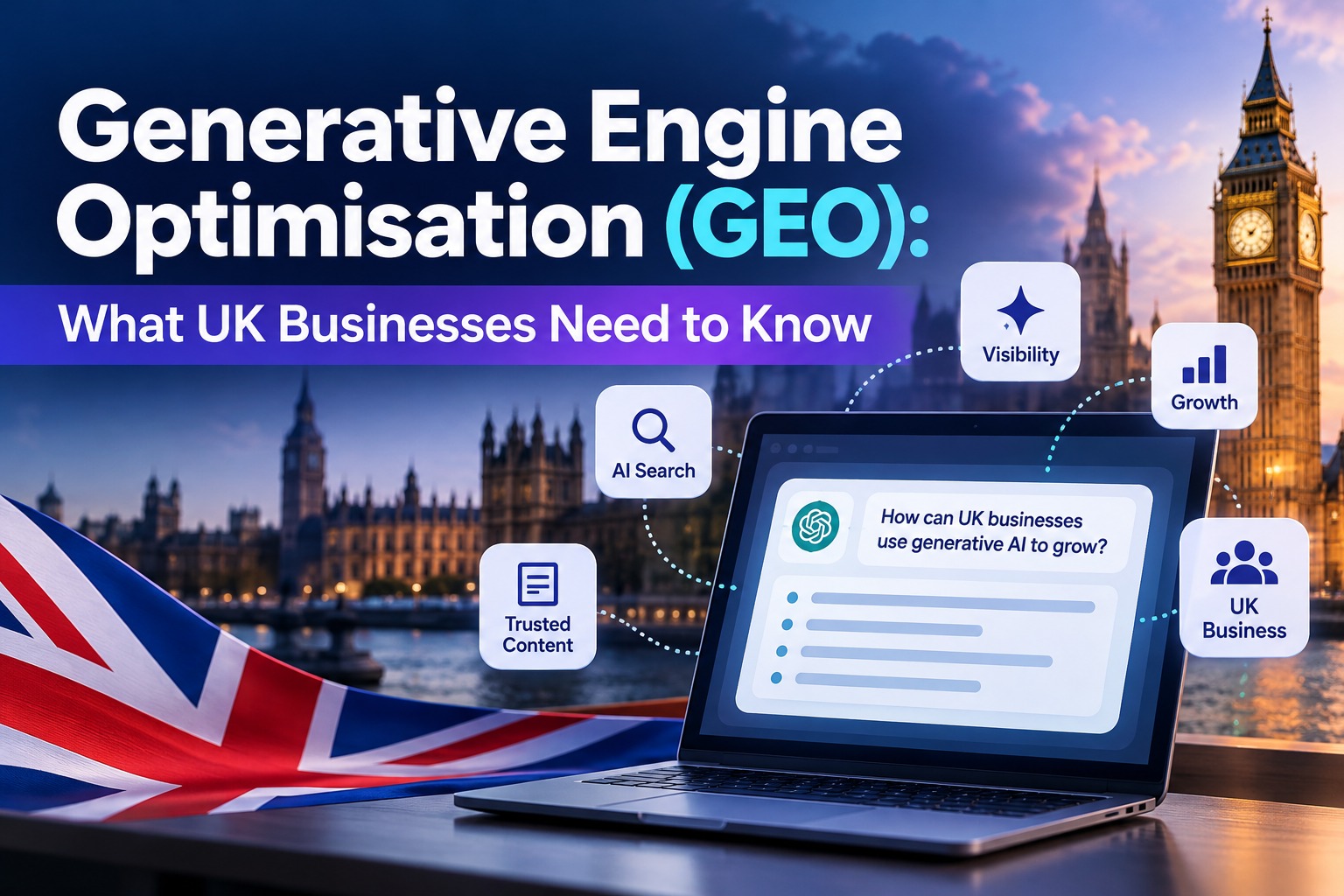
When a prospective client asks an AI-powered search tool to recommend an accountant, solicitor or ecommerce supplier, your website may influence the answer even when the buyer never visits a traditional results page. Generative Engine Optimisation (GEO) helps UK organisations make their expertise easier to find, understand and reference across emerging AI search experiences.
The challenge is not to chase a secret AI ranking formula. It is to strengthen the information, credibility and website foundations that help buyers and search systems evaluate your business.
Featured snippet answer
Generative Engine Optimisation (GEO) is the process of improving a website’s clarity, credibility and discoverability so AI-powered search experiences can understand and potentially reference its content. UK businesses should combine technical SEO, original expertise, structured information and clear answers, then assess whether greater AI visibility contributes to qualified enquiries and sales.
Why Generative Engine Optimisation (GEO) matters to UK businesses
AI-generated summaries and conversational answers can influence which businesses a customer considers. A Manchester manufacturer researching specialist suppliers might request a comparison; a Bristol homeowner might ask for recommended installers; a London finance director might seek an accountant with sector experience. Each journey creates opportunities to be discovered before a conventional website click.
However, appearing in an AI answer is not guaranteed, and visibility does not always translate into traffic. Some answers satisfy the question immediately. Others prompt buyers to verify providers, request quotations or visit a trusted source. This makes lead quality and brand recognition as important as raw impressions.
For B2B services and high-consideration purchases, the commercial opportunity is particularly relevant: detailed questions reveal requirements, constraints and buying intent. GEO should help a business become a credible option when those questions arise.
How GEO differs from traditional SEO
Traditional SEO aims to improve discoverability in search results through relevant content, crawlability, useful site architecture and authority. GEO builds on these foundations but also considers whether information is understandable, quotable, attributable and useful within an AI-generated response.
The two disciplines overlap heavily. Google explains that established SEO best practices continue to apply to AI features in Search; no special AI-only markup is required. See Google Search Central: https://developers.google.com/search/docs/appearance/ai-features
| Priority | Traditional SEO | GEO emphasis |
| Content | Match search intent | Answer specific questions with evidence and context |
| Technical setup | Enable crawling and indexing | Make important facts accessible and consistent |
| Authority | Earn relevant links and trust | Show identifiable expertise and verifiable claims |
| Measurement | Rankings, clicks, conversions | AI referrals, brand demand and qualified enquiries |
Seven practical steps to improve AI search visibility
1. Map the questions customers ask before contacting you
Start with sales calls, enquiry emails, customer-service questions and keyword research. Group questions by buying stage: problem recognition, solution comparison, supplier evaluation and purchase readiness. Prioritise questions where your business has genuine expertise and a relevant service to offer.
For a Birmingham dental practice, topics might include treatment suitability, appointment expectations and pricing factors. For a Leeds construction contractor, they might include project scope, insurance, accreditations and realistic timelines. Avoid publishing generic answers that could describe any competitor.
2. Write answer-first pages backed by experience
Place a direct, accurate answer near the beginning of each relevant section. Follow it with details about when the advice applies, trade-offs, examples and next steps. Identify the author or reviewing specialist where appropriate, and update material when rules, prices or services change.
Original photographs, transparent methodologies, service specifications and well-explained processes can distinguish useful content from mass-produced summaries. Do not invent customer results, awards or endorsements to appear authoritative.
3. Strengthen your technical SEO foundations
Check that important pages are indexable, return successful responses, load reliably and use descriptive page titles and headings. Use logical internal links between services, industries, locations and supporting guidance. Avoid hiding crucial facts inside inaccessible scripts or images.
Review Google Search Console and follow the technical guidance at https://developers.google.com/search/docs/fundamentals/seo-starter-guide. Technical accessibility is a prerequisite for many search discovery pathways, not a promise of inclusion in AI answers.
4. Make your business identity consistent
Keep your trading name, location, contact details, service areas and professional credentials consistent across your site and reputable third-party profiles. Describe exactly what you do, who you serve and where you operate. Clear entity information reduces ambiguity for customers and machines alike.
A multi-location healthcare provider should distinguish its Manchester and Sheffield clinics rather than publishing interchangeable location pages. An ecommerce brand should maintain accurate product details, returns information and delivery policies.
5. Use structured data accurately
Relevant structured data can help search engines interpret page content, provided it reflects what visitors can actually see. Depending on the page, this may include Organisation, LocalBusiness, Product, Article or BreadcrumbList markup. Validate implementation and follow Google’s eligibility guidance; structured data does not guarantee rich results or AI citations.
For regulated services, clearly separate general educational content from individual professional advice. Accuracy and transparent qualifications matter more than adding every possible schema type.
6. Build credible references beyond your website
Earn relevant mentions through professional associations, useful research, genuine partnerships and local business coverage. A Liverpool recruitment firm could publish an evidence-based hiring guide; a Glasgow manufacturer could explain material specifications or procurement considerations. Useful resources are more likely to be referenced than promotional slogans.
Do not buy dubious citations or manufacture reviews. For reputation-building, quality and relevance are more sustainable than volume.
7. Connect visibility to a conversion-ready journey
A buyer who encounters your brand in an AI answer may later search for your company directly. Ensure service pages explain your offer, show appropriate proof, address objections and provide a simple enquiry route. Test mobile usability, form completion and telephone tracking before investing heavily in new content.
BVS Digital combines search strategy with website and conversion considerations. Explore its broader approach at https://bvsdigital.co.uk/ and related guidance at https://bvsdigital.co.uk/digital-marketing-trends-uk-2026/.
A practical 90-day GEO implementation plan
- Days 1-30: Audit crawlability, service pages, business details, analytics and 20-30 high-intent customer questions. Identify content gaps and baseline enquiries.
- Days 31-60: Improve priority pages with direct answers, original expertise, descriptive headings, relevant internal links and validated structured data.
- Days 61-90: Publish supporting comparisons or buyer guides, pursue credible industry mentions and review AI referrals alongside qualified leads and assisted conversions.
Assign a named owner to every task. Prioritise pages already close to generating enquiries rather than attempting to rewrite an entire website at once.
What to measure, and what not to overclaim
AI visibility is difficult to measure consistently because answer formats, prompts, locations and user contexts vary. A single manual prompt test is not reliable proof of market share. Track a basket of indicators, record your testing method and look for directional trends over time.
- Qualified leads, booked consultations and revenue attributable to organic and assisted journeys.
- Referral visits from identifiable AI tools where analytics exposes them.
- Branded searches, direct visits and sales-team mentions of AI-assisted discovery.
- Organic search impressions, clicks and engagement for priority commercial pages.
- A documented sample of recurring buyer prompts, checked consistently without treating results as exhaustive.
Use UK GDPR-compliant analytics and review tracking consent requirements. The Information Commissioner’s Office provides guidance at https://ico.org.uk/for-organisations/direct-marketing-and-privacy-and-electronic-communications/.
Common GEO mistakes that waste budget
- Treating GEO as a replacement for SEO instead of an extension of sound search practices.
- Publishing hundreds of thin AI-written pages without specialist review.
- Promising guaranteed mentions or fixed positions in AI-generated answers.
- Adding unsupported statistics, misleading schema or fabricated testimonials.
- Optimising only for visibility while ignoring enquiry quality and conversion.
- Copying identical local pages for London, Birmingham, Bristol and other service areas.
A sensible GEO programme tests assumptions and adjusts investment based on outcomes. Agencies should be able to explain what they changed, why it matters and how performance will be evaluated.
How GEO applies across UK industries
Law firms can publish carefully reviewed explanations of legal processes, typical decision points and jurisdiction-specific caveats. Accountants can answer practical questions about bookkeeping workflows, reporting responsibilities and choosing an adviser, while linking to authoritative HMRC guidance when needed.
Estate agents can improve neighbourhood and transaction guides with locally verified details. Trades and construction businesses can explain qualifications, project stages and quotation requirements. Retailers can improve product specifications, comparison content and delivery policies. Hotels and restaurants can keep facilities, accessibility information and location details accurate.
Across these sectors, the objective is the same: answer the questions real customers ask and make the next commercial step obvious.
Why work with BVS Digital on GEO?
Generative Engine Optimisation (GEO) works best when content, technical SEO, website experience and reporting are planned together. BVS Digital is a London-based digital marketing agency supporting UK businesses with SEO, digital consultancy, paid advertising and conversion-focused websites.
Rather than chasing unverified AI visibility claims, the team can help identify commercially valuable search questions, improve the pages that answer them and connect marketing activity with meaningful enquiries. Learn more about the agency at https://bvsdigital.co.uk/about/ and its wider digital approach at https://bvsdigital.co.uk/digital-consultancy-for-digital-transformation/.
Plan your Generative Engine Optimisation (GEO) strategy
If your business is concerned about being overlooked as customers use AI-powered search, begin with a practical audit of your content, technical foundations and lead-generation journey. BVS Digital can help prioritise improvements that support discoverability and commercial performance. Discuss your goals at https://bvsdigital.co.uk/contact-us/.
Conclusion: build useful visibility, not AI hype
Generative Engine Optimisation (GEO) is an opportunity to make your expertise clearer and more discoverable, not a shortcut to guaranteed AI recommendations. UK businesses that combine reliable SEO, original information, credible signals and effective conversion journeys will be better placed to compete as search experiences change. Start with customer questions, improve your strongest pages and measure the enquiries that follow.
Frequently Asked Questions
What is Generative Engine Optimisation (GEO) in simple terms?
It means improving your online information so AI-powered search tools can understand your business and may use your content when answering relevant questions. It complements traditional SEO rather than replacing it.
Is GEO different from SEO for UK businesses?
Yes, in emphasis rather than foundations. SEO supports search discoverability; GEO pays particular attention to clear answers, credible evidence and how information may appear in generated responses. Both depend on useful content and sound technical setup.
How long does GEO take to work?
There is no dependable universal timeframe. Technical improvements may be implemented quickly, while stronger content, reputation and measurable commercial outcomes often take longer. Review progress over several months rather than relying on one-off prompt checks.
Can a small UK business compete in AI search?
Potentially. A smaller business can publish highly specific, trustworthy information about its services, locations and expertise. Focus on questions you can answer better than generic publishers, and make it easy for interested buyers to contact you.