
A professional website cannot rely on an attractive homepage alone. The right UK business website pages should take potential customers from their first question through to a confident enquiry, booking, quotation request or purchase.
For businesses competing in London, Manchester, Birmingham, Leeds, Bristol and across the UK, website structure affects far more than appearance. It influences search visibility, trust, user experience and, crucially, how many visitors actually become leads.
Whether you operate a law firm, construction company, dental practice, e-commerce store or professional services business, every important buying question should have a clear place on your website and a logical next action.
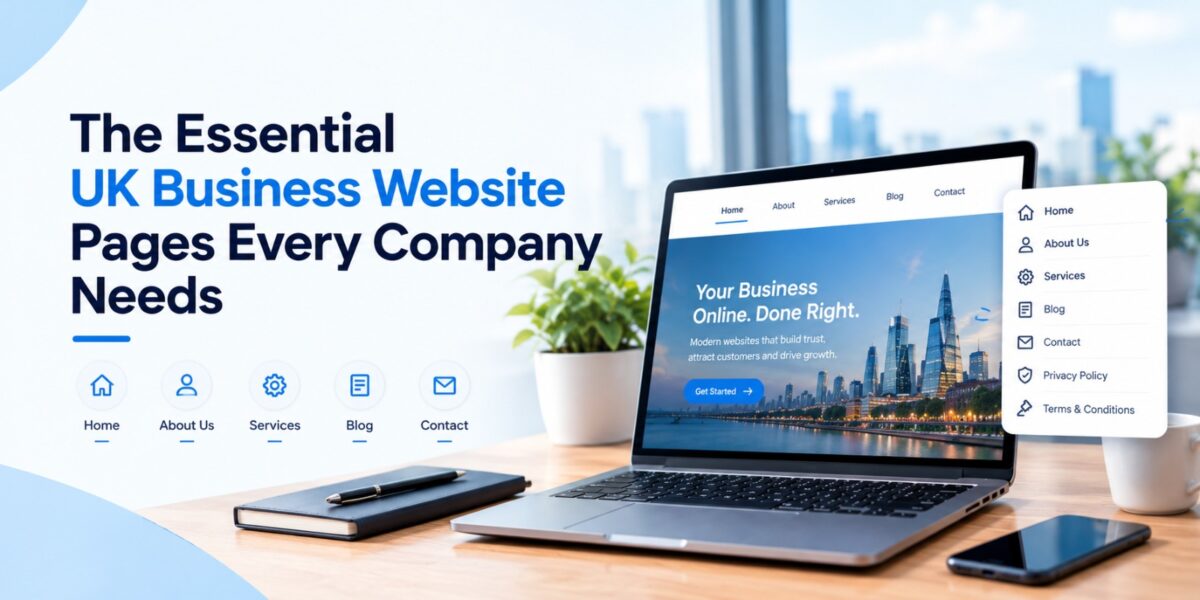
A conversion-focused UK business website should include a clear homepage, About page, dedicated service or product pages, Contact page and appropriate privacy and legal information. Location pages, FAQs, resources, case studies and conversion-focused landing pages can then help businesses attract qualified traffic, overcome buying objections and turn more visitors into enquiries or customers.
Why UK Business Website Pages Matter for Leads and Sales
Website structure should support the way customers make decisions. Someone arriving from Google needs to understand what you provide, whether you can solve their problem, why they should trust you and what they should do next.
If any of those answers are difficult to find, potential customers can leave before contacting your business.
Strong UK business website pages also give search engines clearer information about your services and expertise. Google recommends creating helpful, people-first content and using descriptive headings, links and relevant content to help users and search engines understand websites. Businesses can review Google’s Search Essentials guidance when developing their site architecture.
The commercial goal is therefore not simply to create more pages. It is to build a connected journey that moves visitors closer to action.
- Attract: Match relevant searches with useful service, product and location pages.
- Engage: Explain the problem and demonstrate that you understand the customer’s needs.
- Build trust: Provide evidence, expertise and transparent information.
- Reduce objections: Answer questions about process, timescales, pricing and suitability.
- Convert: Give the visitor a clear, relevant and low-friction next step.
1. Homepage: Turn Initial Interest Into the Next Click
Your homepage is often the first impression visitors receive, but its role is not simply to introduce the company. It should quickly route different types of potential customers towards the information most likely to convert them.
Within the first section of the page, visitors should be able to understand what you do, who you help, and what action they can take.
A conversion-focused homepage should normally provide:
- A clear statement of your core service or value proposition.
- A prominent primary call to action.
- Direct routes to your most commercially important services.
- Trust indicators appropriate to your sector.
- Clear explanations of the problems you solve.
- Relevant geographical coverage.
- Secondary actions for visitors who are not yet ready to enquire.
For example, an accountancy firm might guide prospects directly towards tax services, payroll, bookkeeping and business advisory support. A construction company could direct commercial prospects towards refurbishment, fit-out and project management services.
The homepage should support the rest of your UK business website pages rather than trying to contain everything.
At BVS Digital, we approach website design and development from both a user and commercial perspective. That means thinking about where visitors arrive, what information they need next, and how the website can guide them towards becoming a qualified lead.
2. About Page: Turn Uncertainty Into Trust
Visitors frequently check an About page before committing to a purchase or enquiry. This is particularly common when the service involves high cost, ongoing relationships or professional expertise.
The page should therefore answer a commercial question: Why should a prospective customer feel confident choosing your business?
Useful information may include your organisation’s history, leadership team, relevant professional expertise, qualifications, accreditations, industries served and approach to working with customers.
Avoid filling the page with broad statements such as “we put customers first” without supporting detail. Specific information is more persuasive.
For law firms, accountants, healthcare providers, consultants and financial services businesses, trust is often a conversion requirement rather than a branding extra.
Prospective clients evaluating BVS Digital can similarly use our About page to understand our approach before discussing their requirements.
3. Dedicated Service Pages: Capture High-Intent Prospects
Dedicated service pages are among the most commercially important UK business website pages.
A visitor searching for a specific service is often much closer to making a decision than someone browsing a general business homepage. Each major service should therefore have enough content to answer the questions that influence that decision.
A dental clinic could create dedicated pages for dental implants, cosmetic dentistry and emergency appointments. An estate agency might have separate pages for selling, lettings, valuations and property management.
A strong service page should explain:
- The customer’s problem or objective.
- What the service involves.
- Who the service is suitable for.
- How your process works.
- What differentiates your approach.
- Common questions or concerns.
- Relevant evidence or credentials.
- What the prospective customer should do next.
Calls to action should also match the service. A generic “Contact Us” button can work, but more specific wording such as “Discuss Your SEO Requirements”, “Request a Website Consultation” or “Book an Initial Assessment” can give users a clearer expectation of what happens next.
4. Contact Page: Remove the Final Barrier to Enquiry
Once someone decides to contact your business, the website should make the process straightforward.
Do not require interested prospects to search through the footer or multiple pages for an email address, telephone number or enquiry form.
A conversion-focused Contact page may include:
- A short explanation of what happens after the enquiry.
- A clear telephone number.
- A simple enquiry form.
- Relevant business locations.
- Opening or response hours where appropriate.
- Alternative contact options where useful.
Form length matters. Ask only for information genuinely required to respond effectively. A visitor wanting an initial marketing conversation may not be ready to complete a long questionnaire before speaking to anyone.
It can also help to reassure visitors about what happens after submitting the form. For example, tell them whether someone will contact them to discuss their requirements rather than leaving the next step unclear.
5. Privacy Policy and Cookie Information
Trust can disappear quickly if visitors feel uncertain about how their information will be used.
UK websites collecting personal information through forms, newsletter registrations, accounts or other mechanisms need to consider relevant data protection obligations.
The Information Commissioner’s Office states that organisations processing personal data generally need appropriate privacy information explaining matters such as why information is processed, retention and sharing. Businesses should review the latest ICO privacy notice and cookie guidance.
Privacy information should be easy to locate. A clear privacy approach is not only a compliance consideration; it can also support confidence at the point where visitors are being asked to provide their details.
6. Terms, Company Information and Relevant Legal Pages
The legal information required depends on the type of organisation and how the website operates.
UK limited companies should review their disclosure obligations. GOV.UK states that company websites must show information including the registered company number, registered office address, place of registration and limited company status. Businesses should check current GOV.UK company disclosure guidance.
E-commerce businesses have additional responsibilities relating to areas such as pricing, ordering, cancellation and delivery. GOV.UK provides separate online selling guidance.
Transparent terms can also reduce hesitation. Customers are more likely to move forward when important information about the transaction or relationship is easy to understand.
Which UK Business Website Pages Have the Greatest Conversion Role?
| Page | Primary Role | Conversion Objective |
| Homepage | Orientate and qualify visitors | Move users towards the most relevant service or action |
| About | Build credibility | Reduce uncertainty about the business |
| Service Pages | Explain individual solutions | Convert high-intent visitors into enquiries |
| Case Studies | Provide evidence | Give prospects confidence in capability |
| Location Pages | Establish local relevance | Capture geographically specific enquiries |
| FAQ Content | Resolve objections | Help hesitant visitors move closer to action |
| Contact Page | Facilitate communication | Complete the enquiry journey with minimal friction |
7. Location Pages: Convert Local Search Demand
Location pages can be particularly valuable for businesses operating from several branches or serving clearly defined areas.
A visitor searching for a service in Leeds or Birmingham may want confirmation that the company genuinely serves that area before making contact.
Useful location pages can include:
- Services available in the area.
- Branch or service-area information.
- Relevant local contact details.
- Information specific to local customers.
- A clear location-specific call to action.
An estate agent with several offices, for example, should provide meaningful information about each branch rather than publishing near-identical pages with the location name changed.
The same principle applies to SEO. BVS Digital’s SEO services focus on matching pages with genuine customer search intent and commercial opportunities rather than simply increasing the number of indexed URLs.
8. Blog or Resource Centre: Convert Research Into Commercial Intent
Not everyone arriving at your website is ready to buy immediately. A useful resource section can attract and educate visitors earlier in their decision-making process.
An accountant might explain bookkeeping or tax questions. A solicitor could answer questions around specific legal processes. A manufacturer may create technical guides explaining different applications and product choices.
The conversion opportunity comes from connecting this educational content to the relevant commercial next step.
A useful article about improving Google rankings could link naturally towards SEO services. A website redesign guide could direct businesses towards web design support.
Without these connections, blog traffic can become disconnected from lead generation.
9. Case Studies, Projects or Portfolio Pages: Prove Capability
Potential customers often want evidence before committing to a provider.
Where businesses have appropriate permission and substantiated information, case studies and portfolio pages can demonstrate relevant experience and help prospects understand the type of work delivered.
A useful project page should focus on the business challenge, work undertaken and verifiable outcome where available.
Never invent results or use unsupported performance claims. Credibility is more valuable than exaggerated numbers.
If named customer information cannot be disclosed, anonymised examples may still provide useful context when confidentiality requirements allow.
10. FAQ Content: Remove Buying Objections Before They Block a Lead
FAQs have greater commercial value when they address questions that stop customers from moving forward.
These may include:
- How much does the service cost?
- How long does the process normally take?
- Which businesses is the service suitable for?
- What happens after an enquiry?
- Do you work with businesses in my location?
- What information will you need from me?
Where possible, place relevant FAQs directly on service pages. This allows visitors to overcome objections while they are actively evaluating the service rather than forcing them to search elsewhere.
11. Product and Category Pages: Convert E-Commerce Traffic
E-commerce websites require UK business website pages that support product discovery as well as purchasing confidence.
Category pages should help customers compare options efficiently. Product pages should give buyers enough information to make a decision without unnecessary uncertainty.
Depending on the product, useful information may include:
- Specifications and dimensions.
- Materials or technical information.
- Availability.
- Delivery expectations.
- Returns information.
- Product compatibility or suitability.
- Clear pricing.
- Customer support information.
Conversion friction frequently appears when important information is hidden until checkout. Businesses should consider what customers need to know before asking them to purchase.
How Website Structure Influences Conversion Rate
Having the correct pages is only the first step. The way they connect determines whether users progress through the website or reach a dead end.
Consider a potential customer who lands on a service page through Google. They may want to understand your expertise, compare options, review evidence, and assess your process before contacting you.
A strong journey might therefore look like:
Google Search → Service Page → Evidence or FAQ → About/Trust Information → Contact or Consultation Request
Every unnecessary step creates an opportunity to lose the visitor.
Common conversion barriers include:
- Generic calls to action.
- No obvious next step.
- Too many navigation choices.
- Long enquiry forms.
- Weak mobile usability.
- Important trust information hidden from key pages.
- Service pages focused on the company instead of customer problems.
- Slow-loading pages.
BVS Digital’s conversion rate optimisation services focus on identifying these barriers and improving the journey between initial interest and meaningful action.
What Makes a Website Page Conversion-Focused?
A conversion-focused page does not need aggressive sales language. It needs clarity.
Each important page should answer four questions:
- Why am I on this page? Make the service or topic immediately clear.
- Can this company solve my problem? Explain the relevant solution and benefits.
- Why should I trust them? Provide credible expertise, evidence and reassurance.
- What should I do now? Provide one obvious next action.
This framework can be used across professional services, trades, healthcare, e-commerce and B2B websites.
For a law firm, the action could be requesting an initial conversation. For a construction company, it might be discussing a project. For a retailer, it may be adding a suitable product to the basket.
Common Website Page Mistakes That Cost Enquiries
A website can generate traffic while still underperforming commercially.
One common problem is relying on one generic services page. This forces customers to work harder to determine whether the company provides the exact solution they require.
Another is focusing every page on the organisation rather than the customer’s problem. Visitors generally want to know what you can help them achieve before they want to read lengthy company descriptions.
Other costly mistakes include:
- Hiding contact options.
- Using vague CTA text such as “Learn More” everywhere.
- Failing to explain what happens after an enquiry.
- Creating thin location pages solely for SEO.
- Allowing outdated services or contact information to remain live.
- Publishing content without links towards relevant commercial services.
- Using complicated navigation structures.
- Designing pages for desktop while neglecting mobile visitors.
How BVS Digital Builds Websites Around Commercial Outcomes
A website should not be treated as a collection of individual pages. It should operate as part of your wider lead-generation and customer-acquisition strategy.
At BVS Digital, we consider how web design, SEO, content and conversion strategy work together.
This means looking beyond visual design and asking commercially important questions:
- Which customers is the website trying to attract?
- Which services generate the greatest business value?
- What search intent should each page target?
- What information does a prospect need before making contact?
- Which objections are preventing conversions?
- Where should calls to action appear?
- How can the journey be shortened without reducing useful information?
- How should results be measured after launch?
For a professional services company, the answer may involve clearer service architecture and stronger enquiry pathways. For an e-commerce brand, the priority may be category navigation, product information and reducing checkout friction.
For a multi-location company, BVS Digital may focus on connecting local search visibility with relevant services and clear branch-specific conversion points.
The objective is the same: attract the right visitors and make it easier for them to become customers.
Planning UK Business Website Pages Around Conversions
Before redesigning or expanding your website, map each important page against a commercial purpose.
- Identify your highest-value customer groups. Understand what they need and what motivates them to enquire.
- Map your core services. Give important services dedicated pages rather than hiding them inside broad descriptions.
- Match search intent. Ensure each page answers the reason a visitor is likely to arrive there.
- Identify common objections. Build answers into the appropriate service, FAQ, and supporting pages.
- Add relevant trust signals. Use genuine qualifications, experience, team information or evidence where appropriate.
- Define one primary action. Give each commercially important page a clear conversion objective.
- Reduce friction. Simplify navigation, forms and unnecessary steps.
- Measure performance. Track enquiries, calls, purchases and other meaningful conversion actions.
This turns website planning from a design exercise into a commercial strategy.
Turn Your UK Business Website Pages Into a Lead-Generation System
If your website receives visitors but produces too few enquiries, adding more traffic may not solve the problem. The issue may be how your pages communicate value, answer buying questions and move prospects towards action.
BVS Digital can review your UK business website pages, navigation, service structure, calls to action and conversion journeys to identify where potential customers may be dropping out.
Our approach brings together web design, SEO and conversion thinking so the website is not simply attractive or visible in search. It is structured to support commercially meaningful actions.
Talk to BVS Digital about improving your UK business website pages and discover practical opportunities to turn more of your existing and future website traffic into qualified enquiries.
Conclusion: Build UK Business Website Pages That Work Harder
The strongest websites are not necessarily those with the greatest number of pages. They are the websites where every important page has a clear purpose within the customer’s journey.
Your core UK business website pages should help visitors understand your services, trust your organisation, answer their key questions and take the next step with confidence.
A well-planned homepage, detailed service pages, strong trust content, useful FAQs, relevant location pages and a friction-free Contact page can transform a website from an online brochure into a more effective lead-generation asset.
If your current website attracts traffic without generating enough opportunities, BVS Digital can help connect your web design, SEO and conversion strategy around the outcomes that matter to your business.
Frequently Asked Questions
What pages should a UK small business website have?
Most UK small business websites should include a homepage, About page, individual service or product pages, Contact page and appropriate privacy and legal information. Location pages, FAQs, case studies and useful resources can also improve trust, search visibility and conversion opportunities where they support genuine customer needs.
Which website pages generate the most business enquiries?
Service pages, high-intent landing pages and Contact pages are often particularly important because visitors reaching them may already be considering a purchase. However, About pages, case studies, FAQs and resource content can also influence conversions by reducing uncertainty and helping customers feel confident enough to enquire.
How can I make my business website convert more visitors?
Start by improving clarity. Make each page’s purpose obvious, explain customer benefits, address common objections, provide genuine trust signals and use a clear next action. Simplifying forms, improving mobile usability, and connecting informational content to relevant services can also help reduce conversion friction.
Do separate service pages help SEO and lead generation?
Yes, when each page serves a genuine customer need. Dedicated service pages can target more specific search intent while giving prospects enough information to evaluate the service. They also allow businesses to use more relevant calls to action, answer service-specific questions, and guide high-intent visitors directly towards an enquiry.