
A well-designed digital marketing funnel connects every stage of the customer journey, from first discovering your business to making an enquiry or purchase. Without this structure, marketing channels often operate separately, prospects receive inconsistent messages, and valuable opportunities disappear before they reach the sales team.
For UK businesses, the objective is not simply to attract more website visitors. A successful funnel attracts the right people, answers their questions, builds confidence and guides them towards a commercially valuable action.
FEATURED SNIPPET
An effective digital marketing funnel is a structured customer journey that attracts potential buyers, develops their interest, supports their evaluation and converts them into customers. It combines content, SEO, paid advertising, landing pages, email nurturing, conversion optimisation and measurement around one clear commercial objective.
What Is a Digital Marketing Funnel?
A digital marketing funnel represents the stages people move through before and after becoming customers. It helps a business understand what prospective buyers need at different points in their decision-making process.
Someone discovering an unfamiliar service is unlikely to respond to the same message as a prospect comparing prices or preparing to request a quotation. Each stage requires different content, channels and calls to action.
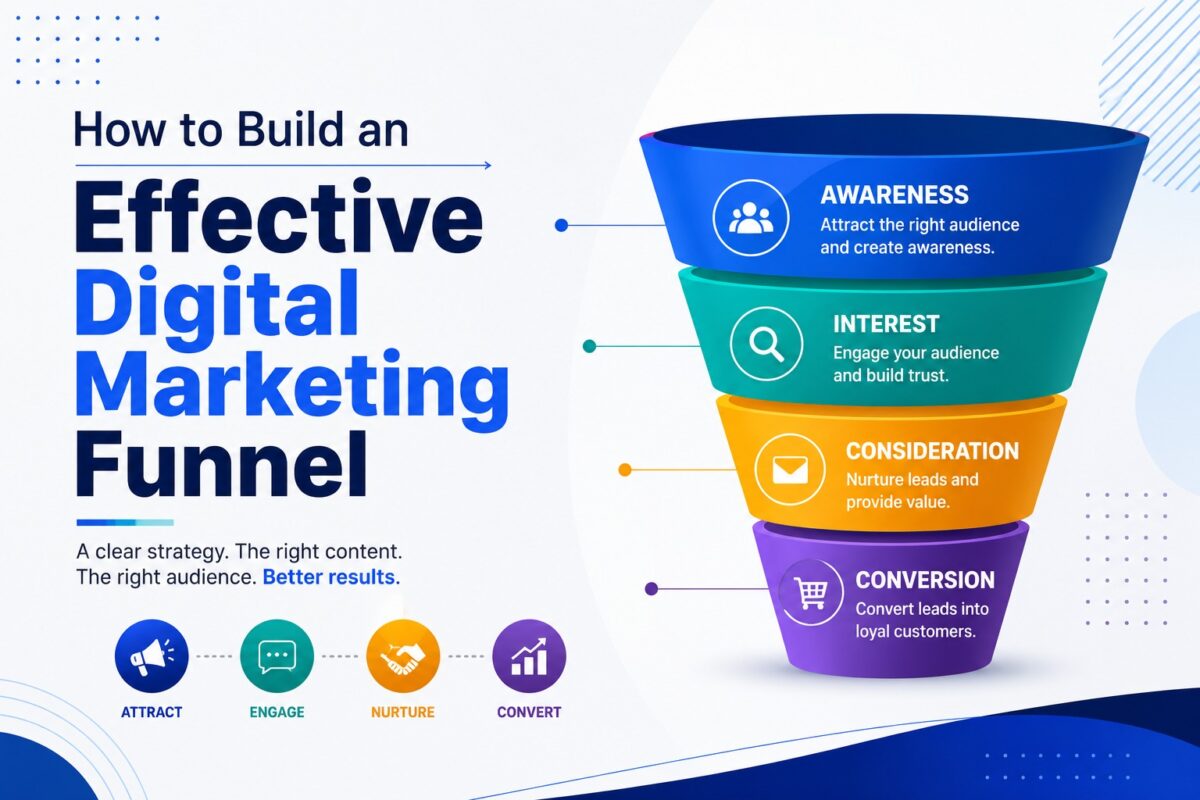
A practical funnel normally contains four core stages:
- Awareness: People discover the business, product or service.
- Consideration: Prospects investigate their problem and compare possible solutions.
- Conversion: Qualified prospects complete an enquiry, booking, purchase or another priority action.
- Retention and advocacy: Customers return, recommend the business or purchase additional services.
The funnel is not always a straight line. A potential customer may read an article, leave the website, see a remarketing advertisement, return through Google and then subscribe to an email sequence before converting. The strategy must therefore create a connected experience across multiple touchpoints.
Why a Digital Marketing Funnel Matters for UK Businesses
Running isolated campaigns can generate traffic without producing sustainable growth. SEO may increase rankings, while paid advertising creates clicks and social media builds engagement. However, these results have limited commercial value when visitors do not know what to do next.
A structured digital marketing funnel solves this problem by aligning channels with customer intent. It gives each campaign a specific purpose and creates a logical path towards conversion.
This matters across many UK industries:
- A law firm in London can guide visitors from an employment law guide to a confidential consultation.
- An accountant in Manchester can convert tax-planning searches into downloadable resources and discovery calls.
- A dental practice in Birmingham can move local searchers from treatment information to appointment requests.
- A construction company in Leeds can use project content, service pages and quotation forms to qualify enquiries.
- An e-commerce retailer in Glasgow can combine buying guides, product comparisons, abandoned-basket emails and remarketing.
- A hotel in Bristol can turn destination searches into direct bookings and repeat-stay offers.
The result is greater control over customer acquisition, clearer performance data and a better opportunity to improve conversion rates.
Digital Marketing Funnel Stages and Their Purpose
| Funnel stage | Customer need | Useful marketing activities | Primary measurement |
|---|---|---|---|
| Awareness | Understand a problem or discover a provider | SEO content, social media, video, display advertising and digital PR | Qualified reach, search visibility and engaged visits |
| Consideration | Evaluate solutions and compare providers | Service pages, buyer guides, webinars, email content and remarketing | Content engagement, return visits and lead capture |
| Conversion | Make a confident decision | Landing pages, consultations, quotations, demonstrations and product pages | Qualified leads, purchases and conversion rate |
| Retention | Receive continued value | Email nurturing, customer support, loyalty offers and educational content | Repeat purchases, retention and customer value |
| Advocacy | Share a positive experience | Review requests, referrals, testimonials and community engagement | Reviews, referrals and recommendations |
How to Build a Digital Marketing Funnel Step by Step
1. Begin with a Measurable Commercial Objective
Define what the funnel must achieve before choosing channels or producing content. A vague goal such as “increase awareness” gives the team little direction. A better objective connects marketing activity with a valuable business outcome.
Depending on the business model, the primary conversion could be:
- A qualified consultation request
- A telephone call from a suitable prospect
- An online appointment or hotel booking
- An e-commerce transaction
- A software demonstration request
- A quotation from a decision-maker
- An event or course registration
Define conversion quality as well as volume. A professional services firm may receive many enquiries but generate little revenue if most leads fall outside its service area, budget or specialist expertise.
2. Define the Priority Audience
An effective digital marketing funnel cannot serve everyone equally. Identify the audience segments most likely to become profitable customers and document their priorities.
For each segment, clarify:
- The problem they are trying to solve
- The event that triggers their search
- The language they use to describe the problem
- Their location, budget and decision timeframe
- The concerns preventing them from acting
- The evidence they need before trusting a provider
- The people involved in approving the purchase
For example, an estate agent may need separate journeys for sellers, landlords and property buyers. A manufacturing company may need different content for procurement managers, technical teams and company directors.
3. Map Search Intent and Customer Questions
Map what the audience searches for at every stage. Awareness searches are normally educational, while conversion-stage searches demonstrate stronger commercial intent.
A buyer may progress through searches such as:
- “Why is my website not generating enquiries?”
- “How does conversion rate optimisation work?”
- “Best CRO services for UK businesses”
- “Conversion rate optimisation agency London”
This research should influence SEO pages, paid search campaigns, downloadable resources, videos and sales conversations. BVS Digital’s search engine optimisation services help businesses connect search demand with commercially relevant website content.
4. Create Awareness Content That Attracts the Right People
The top of the digital marketing funnel should create relevant awareness rather than chase the largest possible audience. Useful content addresses genuine customer problems and establishes the business as a credible source.
Awareness assets may include:
- Search-optimised educational articles
- Short explanatory videos
- Industry guides and checklists
- Social media content
- Research-led thought leadership
- Location-specific resources
A healthcare provider could publish guidance explaining treatment options. A recruitment agency could address common hiring challenges. A home-services company could provide seasonal maintenance advice for homeowners.
Every awareness asset should direct interested users towards a relevant next step. Avoid sending all visitors to the homepage when a focused service page or guide would better match their needs.
5. Build Consideration Content That Reduces Uncertainty
Prospects in the consideration stage already recognise their need. They are now comparing approaches, providers, costs and potential risks.
Useful middle-funnel content includes:
- Detailed service pages
- Comparison guides
- Frequently asked questions
- Process explanations
- Pricing guidance
- Portfolios and authentic customer evidence
- Webinars, calculators or assessment tools
A customer considering a website project may need to understand scope, timelines, ongoing support and how the new site will generate enquiries. BVS Digital’s website design and development services focus on creating usable digital experiences that support business growth.
6. Design Conversion-Focused Landing Pages
When prospects reach the decision stage, the website must make the next action clear and reassuring. A landing page should match the advertisement, search result, email or social post that brought the visitor there.
Strong conversion pages normally include:
- A clear headline reflecting the visitor’s need
- A concise explanation of the service and outcome
- Evidence supporting credibility
- A simple and visible call to action
- Answers to common objections
- A mobile-friendly enquiry or checkout process
- Relevant privacy and consent information
Remove unnecessary choices and fields. A complicated form can discourage genuine prospects, while an extremely short form may provide too little information to assess lead quality. The right balance depends on the value and complexity of the service.
Businesses already generating traffic can use conversion rate optimisation to identify friction and increase the percentage of visitors who take meaningful action.
7. Use Paid Advertising to Capture and Develop Demand
Paid advertising can support several parts of a digital marketing funnel. Google Search campaigns can capture existing demand, while social and video campaigns can introduce a brand to relevant audiences. Remarketing can reconnect with people who visited but did not convert.
Campaign structure should reflect funnel stage. Avoid presenting an immediate “buy now” message to someone who is still learning about a complex service. Likewise, do not send a high-intent searcher to a general educational article when they are ready to request a quotation.
BVS Digital’s paid advertising services can connect targeting, creative, landing pages and conversion measurement around one commercial strategy.
8. Nurture Leads Without Overwhelming Them
Not every prospect will convert during the first visit. Email nurturing can keep the business relevant while the customer researches alternatives or waits for the right time to proceed.
A useful nurturing sequence might:
- Deliver the guide or resource the prospect requested.
- Explain the problem and available approaches.
- Address a common concern or misconception.
- Provide relevant proof or practical examples.
- Invite the prospect to take a suitable next step.
Segment communications according to interests and behaviour. Someone who downloads a local SEO checklist should not automatically receive the same messages as a user who abandons an e-commerce checkout.
UK businesses must also plan direct marketing responsibly. The Information Commissioner’s Office guidance explains relevant responsibilities concerning electronic marketing, privacy and PECR.
9. Track Meaningful Funnel Conversions
Traffic, impressions and clicks help diagnose performance, but they do not show whether the funnel generates commercial value. Measurement should cover meaningful actions across the journey.
Useful metrics include:
- Qualified traffic by channel and landing page
- Engagement with priority content
- Lead-capture completion rate
- Cost per qualified lead
- Sales conversion rate
- Customer acquisition cost
- Revenue by channel or campaign
- Repeat-purchase and retention rate
Google Analytics allows important events to be identified as key events and used for conversion measurement. Businesses can review Google’s guidance on key events and conversions when planning their analytics setup.
Connect marketing data with sales outcomes wherever possible. A campaign delivering cheap leads may appear successful until the business discovers that those leads rarely become customers. The article on measuring digital marketing ROI explains how to connect campaign performance with financial results.
10. Improve the Funnel Continuously
A digital marketing funnel should evolve using evidence from customer behaviour, sales feedback and campaign data. Begin with the stage causing the greatest loss of qualified prospects.
Possible tests include:
- Rewriting a landing-page headline
- Changing the call-to-action wording
- Reducing unnecessary form fields
- Improving page speed and mobile usability
- Adding clearer pricing or process information
- Separating audiences into more relevant campaigns
- Testing different email sequences
- Improving follow-up speed for new enquiries
Test one meaningful variable at a time and allow enough data to make a reliable decision. Random redesigns make it difficult to understand which change affected performance.
Common Digital Marketing Funnel Mistakes
Focusing Only on Awareness
High reach and website traffic can look impressive, but awareness without a suitable next step rarely produces enough revenue. Every campaign should connect to another part of the funnel.
Using the Same Message at Every Stage
Educational messaging is useful early in the journey, while decision-stage prospects need specific information about services, suitability, process and action.
Sending Every Campaign to the Homepage
A homepage must address several audiences. Focused landing pages usually provide a clearer connection between the visitor’s original intent and the desired conversion.
Ignoring Lead Quality
Optimising only for form submissions can encourage poor-quality enquiries. Define what makes a lead valuable and share that information between marketing and sales teams.
Neglecting Existing Customers
The funnel should continue after the first sale. Retention, repeat purchases, referrals and reviews can improve the long-term return from customer acquisition.
Failing to Consider Privacy and Consent
Analytics, remarketing and email nurturing must be planned alongside privacy obligations. Consent mechanisms and data handling should be considered during funnel design, not added as an afterthought.
How BVS Digital Builds Connected Marketing Funnels
BVS Digital approaches funnel development as a commercial strategy rather than a collection of unrelated campaigns. The process can combine audience research, SEO, paid advertising, website design, content, analytics and conversion optimisation around measurable business goals.
This integrated approach helps UK businesses:
- Attract prospects with stronger commercial relevance
- Create consistent journeys across marketing channels
- Develop content for each decision stage
- Improve landing-page and enquiry performance
- Measure lead quality and return on investment
- Identify and correct weak points in the customer journey
Through its digital consultancy services, BVS Digital can help businesses develop a practical funnel aligned with their market, customer behaviour, internal resources and growth objectives.
Conclusion: Turn Marketing Activity into a Connected Growth System
An effective digital marketing funnel gives every channel a defined role in attracting, educating, converting and retaining customers. It replaces disconnected activity with a measurable journey built around customer needs and commercial outcomes.
Start with one valuable audience, one conversion objective and one clearly mapped journey. Measure where qualified prospects disengage, improve that stage and continue refining the experience using reliable data.
If your campaigns are generating activity without enough qualified enquiries or sales, BVS Digital can help you create a connected digital marketing funnel that improves customer acquisition and conversion performance. Contact BVS Digital to discuss a funnel strategy tailored to your UK business.
Frequently Asked Questions
What are the main stages of a digital marketing funnel?
The main stages are awareness, consideration, conversion, retention and advocacy. Businesses should provide different content and calls to action at each stage because customer needs and purchase intent change throughout the journey.
How long does it take to build a digital marketing funnel?
A basic funnel can be planned and launched within several weeks, but timing depends on the number of audience segments, required content, website development, tracking and marketing channels. Continuous testing and improvement should continue after launch.
Which channels should a small UK business include in its funnel?
The right combination depends on customer behaviour and budget. Many SMEs begin with SEO, commercially focused website pages, Google Ads, email nurturing and conversion tracking before expanding into social media, video or remarketing.
How do I know whether my digital marketing funnel is working?
Track qualified traffic, stage-to-stage progression, conversion rate, cost per qualified lead, sales conversion rate, customer acquisition cost and revenue. These measurements show whether the funnel is producing valuable customers rather than surface-level engagement.