
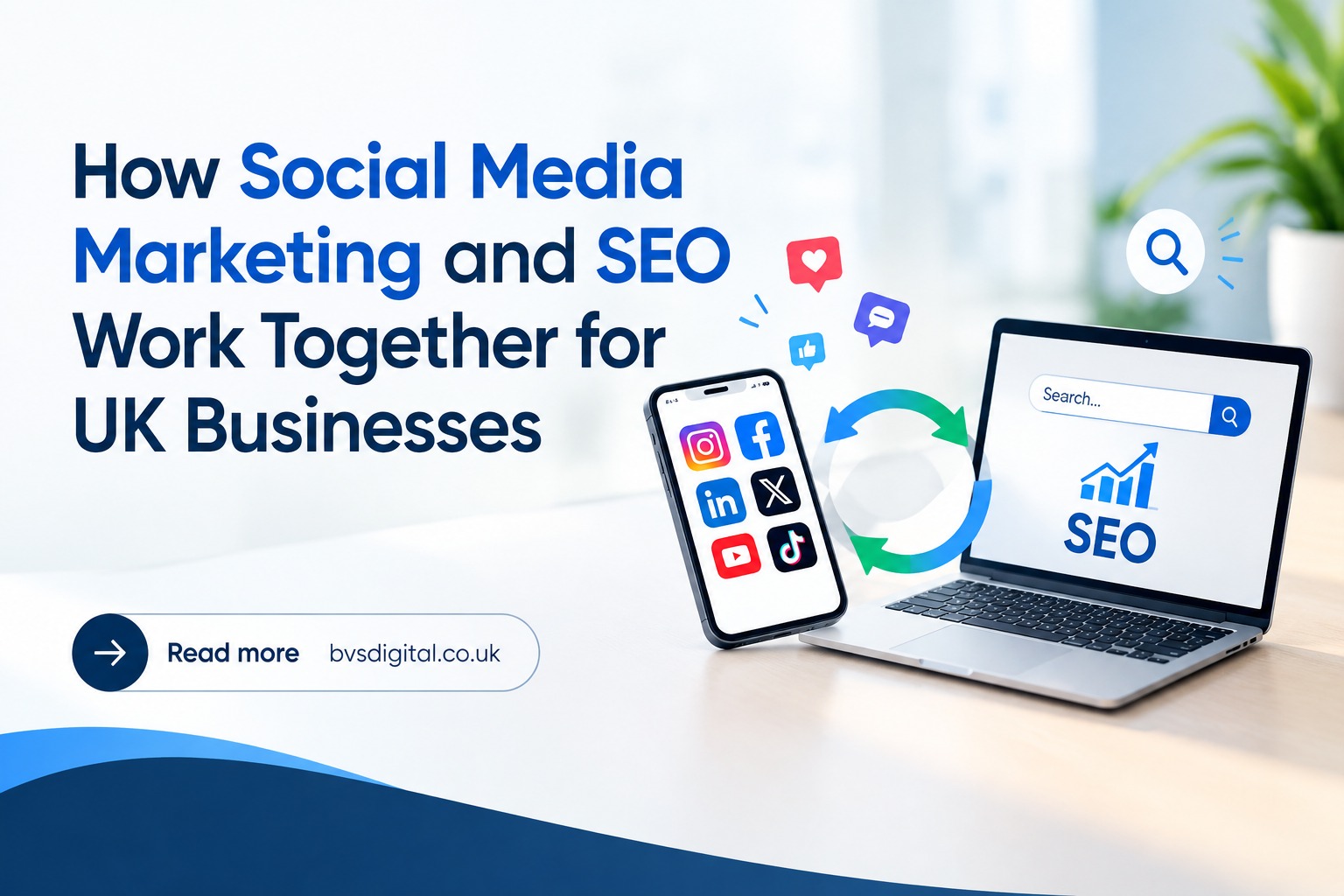
Social media marketing and SEO are often treated as separate digital marketing activities. SEO focuses on helping a business appear when potential customers search online, while social media is generally used to build awareness, distribute content and engage with audiences.
For UK businesses, however, these channels can become considerably more effective when they support each other.
A potential customer might first discover a company through LinkedIn, Instagram, Facebook, TikTok or YouTube, visit its website, search for the company again on Google and eventually make an enquiry.
Another customer may discover an article through Google, follow the company on social media and return several weeks later when they are ready to buy.
This means businesses should not think about SEO and social media as isolated marketing channels.
Social media and SEO work together by increasing content visibility, driving relevant website traffic, strengthening brand awareness, creating opportunities for backlinks, and helping businesses understand what their customers want to know. Social media engagement itself does not automatically improve Google rankings, but it can support the wider activities that strengthen search visibility and customer acquisition.
Why Social Media and SEO UK Businesses Should Work Together
Customer journeys are increasingly fragmented.
Someone looking for an accountant in Manchester, a web design agency in London, an estate agent in Birmingham or a solicitor in Leeds may move between several platforms before contacting a business.
- Google Search
- Google Maps
- TikTok
- YouTube
- Online reviews
- Company websites
This means businesses can no longer assume that a customer will discover them through one channel and immediately convert.
SEO can help capture customers who are actively searching. Social media can help introduce the brand earlier, maintain awareness and distribute useful content. A website then needs to convert that interest into an enquiry, sale or other meaningful business action.
UK businesses that need help connecting these channels can use digital marketing consultancy to create a coordinated strategy around customer acquisition rather than managing every platform independently.
How Social Media Marketing and SEO Support Each Other
| Area | SEO Contribution | Social Media Contribution |
| Content visibility | Helps content appear in search results | Distributes content to wider audiences |
| Website traffic | Attracts users actively searching | Generates referral and discovery traffic |
| Brand awareness | Builds visibility around relevant searches | Repeatedly exposes audiences to the brand |
| Content development | Identifies search demand and keywords | Identifies questions, discussions and trends |
| Backlink opportunities | Benefits from relevant earned links | Helps useful content reach publishers and industry audiences |
| Local visibility | Supports local pages and search optimisation | Builds local engagement and community awareness |
| Customer journey | Captures high-intent search demand | Supports awareness and consideration |
| Measurement | Tracks search visibility and organic conversions | Tracks engagement, referral traffic and audience response |
1. Social Media Helps More People Discover SEO Content
Creating good content is only part of an effective SEO strategy. Businesses must also help the right audience discover it.
A UK accountancy company, for example, could publish an article titled “Tax Planning Tips for UK Small Businesses.” The article may gradually attract visitors through Google.
The company could then promote the same content through LinkedIn posts, Facebook updates, Instagram carousels, short educational videos, email newsletters and YouTube videos.
Instead of creating completely separate content for every marketing channel, one useful piece of website content becomes the foundation for multiple digital assets.
What UK businesses should do?
- Five short social posts
- One LinkedIn discussion
- One infographic
- Three short videos
- Several customer tips
- One email newsletter
- One longer YouTube explanation
2. Social Media Can Increase Relevant Website Traffic
One of the clearest ways social media can support an SEO-led strategy is by driving visitors to useful website pages.
A potential customer may initially see an educational post on LinkedIn or Instagram, then click through to a service page, guide, case study, product page, location page or blog article.
This traffic does not need to originate from Google to be commercially valuable. More importantly, customers often return through a different channel later.
For example: LinkedIn post → Website visit → Brand familiarity → Google search → Service page → Enquiry.
Businesses should therefore measure how channels support one another instead of attributing every conversion only to the final website visit.
3. Social Media Can Increase Brand Awareness and Branded Search
When customers repeatedly encounter a company through social media, they can become more familiar with the brand.
This can influence how they search later. A potential customer might initially search “SEO company UK,” but after seeing a company regularly on LinkedIn, they may later search “BVS Digital SEO” or simply “BVS Digital.”
These are branded searches. Branded search behaviour is commercially important because the potential customer already knows which company they want to investigate.
Social media can therefore help businesses build familiarity before customers are ready to make an enquiry.
Build recognisable brands, not only social accounts
- Website
- YouTube
- Google Business Profile
- Email communication
- Paid advertising
4. Social Media Can Create Opportunities for Backlinks
Backlinks remain an important part of SEO. However, earning good links usually requires content that other people genuinely find useful.
Social media can help that content reach journalists, bloggers, industry publications, business owners, professional associations, analysts, researchers and customers.
Consider a UK company publishing an original industry report. If the company promotes the findings through LinkedIn, journalists or industry professionals may discover the research and reference it from their own websites.
The social media share itself is not necessarily the SEO benefit. The earned website mention or backlink generated because the content was discovered can provide longer-term value.
Content most likely to attract links
- Original research
- Industry statistics
- Detailed guides
- Surveys
- Unique data
- Expert commentary
- Market analysis
- Useful tools
- Strong case studies
5. SEO Research Can Improve Social Media Content
The relationship also works in the opposite direction. SEO research can help social media teams understand what customers actively want to know.
Keyword research and search data can reveal common customer questions, product comparisons, service concerns, pricing questions, location-based demand, seasonal interest, and problems customers need solved.
A UK web design company may identify searches such as “How much does a website cost in the UK?”, “How long does a website redesign take?”, “What makes a good business website?”, “Does website speed affect SEO?” and “Should small businesses use WordPress?”
Each search query could become an article, LinkedIn post, Instagram carousel, short video, customer FAQ or social poll.
SEO research therefore helps businesses avoid creating social media content purely based on guesswork.
6. Social Media Can Generate New SEO Content Ideas
Social media provides another valuable source of customer insight.
Businesses should monitor comments, direct messages, questions, popular posts, customer objections, industry discussions, competitor conversations and repeated service enquiries.
These discussions can reveal subjects worth developing into more detailed website content.
The process becomes: Customer question → Social discussion → SEO content → Social promotion → Website traffic → Additional questions.
This creates a continuous marketing content cycle.
7. One SEO Article Can Support an Entire Social Media Campaign
Businesses frequently struggle to produce enough social content. A connected SEO and social media strategy can reduce that pressure.
Instead of creating something completely new every day, businesses can repurpose strong website content.
Consider an article titled “How Much Does SEO Cost in the UK?” That single article could become a LinkedIn post about pricing factors, an Instagram carousel, a Facebook explainer, a short TikTok or Reel, a YouTube discussion, and an email linking back to the complete article.
The business has created multiple customer touchpoints from one high-quality core topic. This approach is generally more efficient than creating disconnected content for every platform.
8. Social Media and Local SEO Can Support Each Other
Social media and search can also work together effectively for local UK businesses.
This is particularly relevant for restaurants, dental clinics, solicitors, estate agents, accountants, beauty clinics, builders, electricians, gyms and retailers.
A potential customer may discover the company in Google Maps and then check Instagram to see recent photographs. Another customer may see a Facebook post and later search Google for directions, opening hours or reviews.
Local businesses should therefore provide consistent information across digital channels.
Key areas to keep consistent
- Business name
- Location
- Telephone number
- Website address
- Opening hours
- Service information
- Branding
- Photographs
- Contact details
9. Social Media Can Strengthen Customer Trust Before Conversion
SEO can attract a customer to a website, but visibility alone does not guarantee an enquiry.
Potential customers frequently investigate companies before making contact. They may want to know whether the company is active, demonstrates expertise, shows recent work, shares genuine customer experiences, communicates clearly and appears credible.
Social media can provide supporting evidence. A professional services firm might publish expert commentary, a construction company may show current projects, a restaurant can display recent dishes, an automotive company can explain its vehicle selection process, and a web agency can showcase completed websites.
This content can help potential customers become more comfortable with the organisation before making an enquiry.
10. Social Media Can Support Modern Search Discovery
Search behaviour is expanding beyond traditional Google searches.
Potential customers increasingly discover information through different digital platforms depending on the question they are trying to answer.
A user may search Google for a service, search YouTube for an explanation, check TikTok for demonstrations, use LinkedIn for professional expertise, check Instagram for visual evidence and read reviews before contacting a company.
Businesses should therefore think in terms of digital discoverability rather than only traditional website rankings.
The objective is to provide useful, consistent information wherever relevant customers research their options. This does not make traditional SEO less important; it makes strong content more valuable because the same expertise can be adapted to support several discovery environments.
11. Social Media Should Not Be Treated as a Direct Google Ranking Shortcut
One of the most common misunderstandings around social media and SEO is that more followers, likes or shares automatically produce better Google rankings.
Businesses should avoid this assumption. Social media should instead be viewed as a distribution and visibility channel that can indirectly support a wider SEO strategy.
- Increase content exposure
- Generate website visits
- Strengthen brand recognition
- Reach potential link sources
- Identify customer questions
- Repurpose SEO content
- Build customer familiarity
- Support wider digital discovery
12. SEO and Social Media Data Can Improve Each Other
Integrated measurement can help businesses understand which topics and messages genuinely interest customers.
SEO teams can examine search queries, landing-page traffic, organic conversions, keyword visibility and website engagement. Social media teams can examine content engagement, video views, referral traffic, audience responses, comments, shares and enquiries.
When these insights are combined, businesses can identify stronger content opportunities.
For example, an article receiving significant organic traffic may deserve additional social promotion, while a social media post generating unusually strong engagement may justify creating a detailed search-optimised guide around the same subject.
The most useful data often comes from connecting the two channels.
A Practical Social Media and SEO Strategy for UK Businesses
- Research customer demand. Identify search queries, customer questions, social discussions, competitor topics, service enquiries and common customer problems.
- Create strong website content. Develop useful service pages, blog articles, guides, case studies, FAQs, product information and local landing pages.
- Optimise the content for search. Use clear page titles, relevant headings, useful internal links, strong page structure, descriptive URLs, relevant keywords and accurate business information.
- Repurpose the content for social channels. Turn major website content into LinkedIn posts, Instagram carousels, Facebook posts, short videos, YouTube content and social graphics.
- Send users to relevant website pages. Avoid directing every social media visitor to the homepage. Send them to the page that directly supports their interest.
- Measure commercial outcomes. Track organic traffic, social referral traffic, enquiries, qualified leads, revenue, branded searches, backlinks, landing-page performance and conversion rates.
- Use results to improve future content. The best-performing topics should influence future SEO and social content planning.
Common Social Media and SEO Mistakes to Avoid
Combining social media and SEO does not mean simply publishing the same content everywhere.
- Assuming social media likes directly increase Google rankings
- Publishing social content without understanding the customer
- Creating SEO articles without promoting them
- Sending every social visitor to the homepage
- Focusing only on followers instead of customers
- Creating separate content strategies for every channel
- Ignoring customer questions in social comments
- Publishing generic AI-generated content without useful expertise
- Measuring clicks and likes without connecting them to enquiries
- Treating SEO and social media teams as completely separate functions
The objective is not to maximise activity. The objective is to make each digital channel contribute to shared commercial goals.
How UK Businesses Should Connect SEO and Social Media
- Audit existing content. Identify website pages and articles that already contain useful information.
- Review customer questions. Analyse both search queries and social conversations.
- Identify priority topics. Focus on subjects closely connected to customer demand and business services.
- Build strong core content. Create detailed website resources that demonstrate expertise.
- Develop social assets from the core content. Adapt each topic to suit different platforms.
- Connect social content to the appropriate website page. Create a clear journey from discovery to deeper information.
- Measure enquiries and conversions. Evaluate whether the combined strategy is contributing to commercial results.
- Continuously improve. Use search and social performance data to identify new topics and opportunities.
Why Work with BVS Digital?
Many UK businesses already invest in SEO and social media marketing but manage them as completely separate activities. This can result in duplicated content, inconsistent messaging and missed opportunities.
BVS Digital takes an integrated approach that connects SEO, social media marketing, website development, content marketing, paid advertising, conversion optimisation and digital strategy.
The objective is not simply to increase rankings, followers or website traffic. It is to create a digital marketing system where each channel contributes to stronger visibility, better customer journeys and measurable business opportunities.
Whether you operate a professional services business in London, an e-commerce brand selling across the UK, a local company in Manchester or a multi-location organisation, BVS Digital can help develop a connected strategy around your commercial objectives.
Connect Your SEO and Social Media Strategy
SEO helps your business become visible when potential customers are actively searching. Social media helps your business build awareness, distribute expertise and remain visible throughout the customer journey.
Used together, the two channels can become significantly more effective.
If your business currently manages SEO and social media separately, BVS Digital can assess how your content, search visibility, social activity and website performance can work together more effectively.
Contact BVS Digital to discuss an integrated SEO and social media marketing strategy for your UK business.
Conclusion: Creating a Stronger Digital Presence Through Search and Social
Social media marketing and SEO serve different purposes, but they should not operate in isolation.
SEO can capture high-intent search demand. Social media can increase content discovery, build brand familiarity, and maintain engagement with potential customers.
Strong website content can fuel social media campaigns. Social conversations can generate new SEO ideas. Social distribution can expose useful content to wider audiences, while search visibility can continue generating traffic long after a social post has disappeared from a user’s feed.
The strongest strategy is therefore not SEO versus social media. It is understanding how each channel contributes to the customer’s journey.
For UK businesses, the objective should be to create useful content, increase its visibility, build brand trust and make it easy for potential customers to move from discovery to enquiry.
When SEO, social media, content and website performance operate as one connected strategy, businesses can build a stronger and more sustainable digital presence.
Frequently Asked Questions
Does social media improve SEO?
Social media activity does not automatically increase Google rankings. However, it can indirectly support SEO by increasing content visibility, generating website traffic, strengthening brand awareness and creating opportunities for websites and publishers to discover and link to useful content.
Should UK businesses invest in SEO or social media?
The most appropriate balance depends on the business, customer journey and objectives. SEO can be particularly valuable for capturing people actively searching for products or services, while social media can support awareness, engagement and content distribution. Many businesses benefit from using the two together.
Can social media help generate backlinks?
Yes. Sharing useful research, guides, expert commentary and other valuable resources can help journalists, bloggers, businesses and industry organisations discover the content. Some may then reference or link to the original website.
How can SEO improve social media marketing?
SEO research can reveal what potential customers are searching for. Businesses can use those questions, keywords and topics to create more relevant LinkedIn posts, videos, carousels and other social content.
Which social media platform is best for SEO?
There is no single platform that is best for SEO. The appropriate platform depends on where the target audience spends time. LinkedIn may be useful for B2B companies, while Instagram or TikTok may be more appropriate for visual consumer brands. YouTube can also be valuable for educational and demonstration content.
Should every social media post link to the website?
No. Social media should also provide useful content directly within the platform. Website links should be used when there is a genuine reason for the customer to access more detailed information, view a service, read a guide or take the next step.
What should UK businesses measure across SEO and social media?
Businesses should look beyond rankings, followers and likes. Useful measurements include organic traffic, social referral traffic, qualified enquiries, branded search activity, backlinks, conversions, customer acquisition and revenue.