

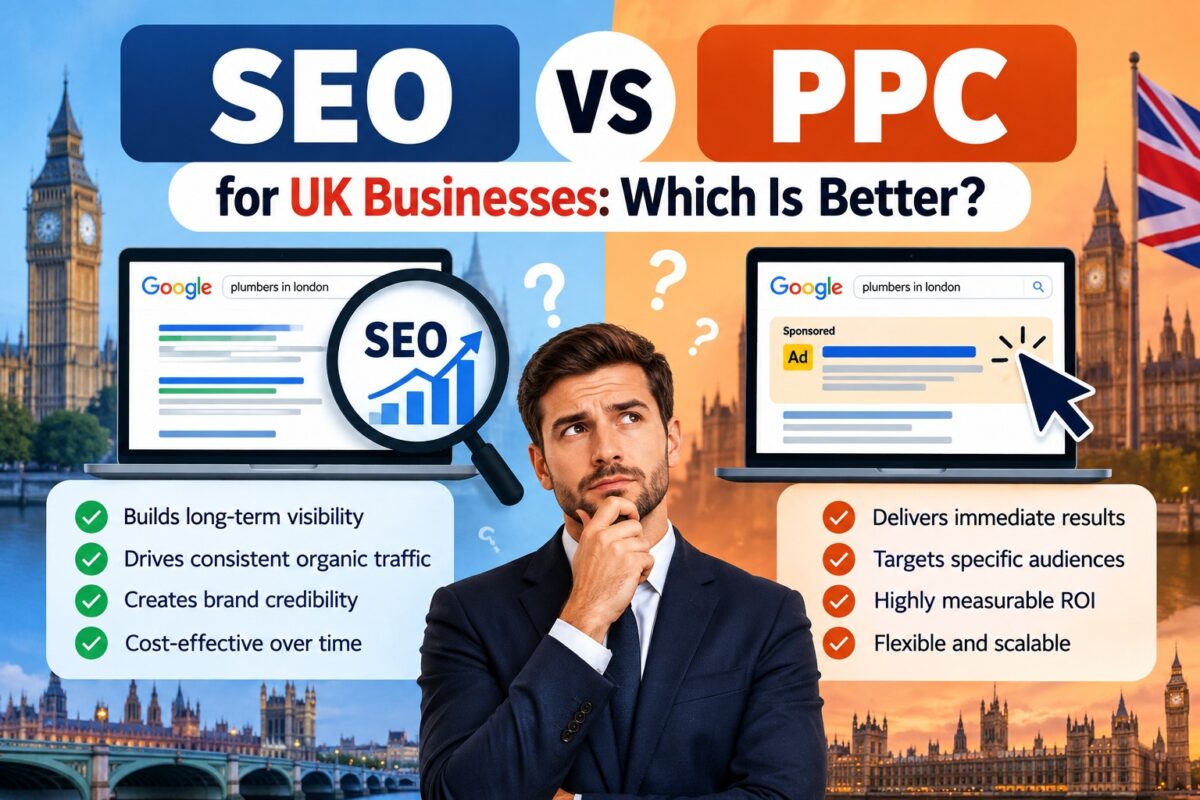
A Manchester accountancy firm wants a steadier flow of enquiries. A new Birmingham home services company needs bookings this month. Both want to appear when customers search Google, but their priorities point towards different investments.
The decision on SEO vs PPC for UK businesses depends on how soon you need leads, your budget, your market and what happens after someone reaches your website. This guide helps you choose a sensible starting point and understand when using both makes commercial sense.
SEO is usually the stronger choice when a UK business can invest consistently in useful pages and wants lasting organic visibility. PPC is better suited to reaching relevant searchers quickly, provided the business can fund and manage campaigns. Many businesses benefit from both: PPC tests immediate demand while SEO builds visibility over time.
What Is the Difference Between SEO and PPC
Search engine optimisation, or SEO, improves how well your website serves people searching for your products or services. The work may include technical fixes, clearer service pages, useful content and local search improvements. You do not pay Google for a click on an organic result, but you do pay for the work needed to improve and maintain your site. Google does not accept payment to rank a page higher in organic search. Google explains how organic search results are selected.
Pay-per-click advertising, or PPC, places ads in eligible search results. With Google Ads search campaigns, you set a budget and bidding approach, then pay when someone clicks your ad. Your bid alone does not determine whether an ad appears or where it is placed; relevance and ad quality also matter. Google Ads explains how campaign budgets and bids work.
The practical distinction is control over timing. A suitable PPC campaign can begin reaching searchers once it is approved and running. SEO improvements need time to be discovered, assessed and reflected in search results. Neither channel guarantees enquiries: the search term, offer, page experience and follow-up all influence the outcome.
SEO vs PPC for UK Businesses: A Practical Comparison
| Decision factor | SEO | PPC |
|---|---|---|
| Time to visibility | Usually gradual; existing site strength and competition matter | Can begin after campaign setup and approval |
| How you pay | For strategy, content, technical work and ongoing improvement | For ad management and clicks or other campaign costs |
| Traffic when spending stops | Established pages may keep attracting visits, but performance can change | Ads stop generating traffic when the campaign is paused |
| Control | Control over your website; limited control over rankings | More direct control over targeting, messaging and budget |
| Best starting use | Building visibility for valuable searches over time | Testing or capturing demand sooner |
| Main commercial measure | Qualified organic enquiries and revenue | Qualified paid enquiries, acquisition cost and revenue |
SEO vs PPC for UK businesses is therefore a question about the job each channel needs to do. A newly launched service may need paid search while its website earns organic visibility. An established company with strong rankings may use PPC selectively for priority services or locations.
When Is SEO the Better Investment
SEO is a good fit when customers regularly research a service before enquiring, and your business can invest beyond the next few weeks. It helps you answer questions, explain your offer and make important pages easier to find.
For example, a London law firm may need clear pages for each service and the areas it serves. A Sheffield manufacturer may need detailed product and capability pages for buyers comparing suppliers. A Bristol hotel may benefit from pages that answer specific questions about its facilities and location. In each case, relevant visitors matter more than a headline traffic figure.
A useful SEO plan starts with the searches most closely connected to revenue. Review whether those searches deserve a service page, a location page, a comparison or an informative guide. Then check that visitors can understand the offer and take the next step. BVS Digital’s search engine optimisation service covers keyword strategy, audits, on-page improvements and local visibility.
What SEO can do well?
- Helpful answers. Give potential customers useful information throughout a longer buying journey.
- Local reach. Improve the visibility of services across relevant UK locations.
- Stronger pages. Improve pages that support enquiries from other channels too.
- Less reliance on ads. Reduce dependence on paid clicks for searches where your pages perform well.
Organic visibility takes ongoing attention. Competitors can improve their pages, customer needs can change, and rankings are never guaranteed. Measure qualified enquiries and sales alongside visibility so you can tell whether the work supports business growth.
When Is PPC the Better Investment
PPC is useful when speed, precise targeting or a defined campaign period matters. A new Leeds clinic may want to test demand for an appointment type. A Liverpool retailer may need visibility for a seasonal range. A construction supplier may want enquiries for one profitable product category before committing to a wider content programme.
The advantage is the ability to choose a focused set of searches, locations and messages, then review what happens. You can adjust a campaign as evidence comes in. That flexibility has a cost: every click uses budget, including clicks that do not become customers.
Before launching, decide what a worthwhile enquiry looks like. Check your likely margin, how often enquiries become sales and whether your team can respond promptly. BVS Digital’s paid advertising service can help connect campaign targeting and messaging with those commercial goals.
What PPC can do well?
- Fast access. Reach people searching for a priority product or service sooner.
- Useful tests. See which searches and offers produce valuable enquiries.
- Location focus. Focus spend on selected locations, such as Glasgow or specific London boroughs.
- Campaign support. Promote launches, limited campaigns and services with immediate demand.
Do not treat the click as the result. If an ad promises a specific service but sends visitors to a general homepage, the opportunity may be lost. A relevant landing page, clear contact route and reliable conversion tracking are essential.
How Should a UK Business Choose Its First Priority
For SEO vs PPC for UK businesses, start with your constraints rather than a preferred marketing tactic. Work through these five questions with your sales and marketing teams:
- When do you need enquiries? If you need to test demand soon, a tightly focused PPC campaign may be appropriate. If you are planning for sustained growth, build an SEO programme as well.
- How much can you invest consistently? Include website improvements, campaign management and ad spend where relevant. A small budget spread across too many services and locations can be difficult to evaluate.
- What is a customer worth? Consider margin and the rate at which enquiries turn into customers. An expensive click may be viable for a high-value service; a cheaper click may still be unprofitable.
- Is your website ready to convert? Visitors need a clear offer, credible information and a straightforward way to enquire. Fix major obstacles before paying to send more people to the page.
- Can you measure the outcome? Agree on the leads and sales that count, then review both volume and quality.
A nationwide e-commerce business and a local trades company may reach different answers, even with similar budgets. The retailer might test PPC for products with healthy margins while improving category pages. The trades company might strengthen its local service pages first, then advertise only its highest-priority jobs.
When Does Using SEO and PPC Together Make Sense
SEO and PPC can address different stages of the same opportunity. Paid campaigns can test whether searches lead to worthwhile enquiries. Those findings can inform which service pages deserve deeper investment. Organic pages, in turn, can give visitors more detail when they want to assess your business before contacting you.
Suppose an estate agency expands into a new area. A focused PPC campaign could test demand for a specific service while the agency develops useful local pages. The team should review actual enquiries from both channels before increasing spend or expanding the site. The same approach can work for recruitment firms, dentists and professional services, with appropriate messaging for each audience.
Keep the reporting connected. Compare leads by service, location and quality rather than assuming each channel works independently. If visitors arrive but do not enquire, examine the offer and page experience. BVS Digital’s conversion rate optimisation service focuses on improving what happens after a visitor lands on your site.
Common Mistakes That Weaken Both Channels
- Broad targeting. More traffic or clicks will not help if those visitors are unlikely to buy.
- Generic landing pages. Match the page to the service, location and question behind the search.
- Judging SEO too soon. Set review points that account for the work, starting position and competition.
- Unattended PPC campaigns. Review search terms, costs and enquiry quality so spend follows useful demand.
- Counting every form as a good lead. Ask the sales team which enquiries were relevant and became customers.
- Ignoring the website experience. Confusing navigation and difficult forms can waste visitors from either channel.
Why Work with BVS Digital
The right answer to SEO vs PPC for UK businesses should come from your objectives, capacity and evidence. BVS Digital brings search optimisation, paid advertising and conversion improvement into the same discussion, so the recommendation reflects the enquiries you need rather than a channel in isolation.
That starts with understanding your services, target locations, existing website and lead quality. The next step is to prioritise the searches and pages most likely to support your goals, then measure what those efforts produce. You can explore BVS Digital’s wider approach on the BVS Digital homepage.
Conclusion: Which Should You Choose
For SEO vs PPC for UK businesses, choose SEO when you can build towards sustained visibility for valuable searches. Choose PPC when you need a controlled way to reach and test demand sooner. Use both when the business case supports immediate campaigns alongside longer-term website improvements.
If you are unsure where your budget will have the greatest effect, contact BVS Digital. We can help assess your website, target searches and enquiry goals, then identify a practical starting point for SEO vs PPC for UK businesses.
Frequently Asked Questions
Is SEO or PPC better for a small UK business?
It depends on your timeline, budget and service. A small business needing enquiries soon may start with a focused PPC test. One that can invest steadily in its website may prioritise SEO. Check the value and quality of leads before committing more budget to either approach.
Is SEO cheaper than Google Ads?
Organic clicks do not carry an ad charge, but SEO still requires investment in research, content, technical improvements and maintenance. Google Ads adds campaign costs and ad spend. Compare the total cost of generating a qualified customer, not simply the price of a click.
How long does SEO take compared with PPC?
A PPC campaign can begin attracting clicks once it is properly set up, approved and running. SEO changes generally take longer to affect visibility, and the timing varies by website and competition. Neither channel guarantees that traffic will turn into enquiries.
Should I stop PPC once my website ranks organically?
Review the evidence first. Ads may still help with priority services, locations or seasonal demand. Compare overall qualified leads and revenue when both channels run, then test budget changes carefully rather than assuming an organic ranking replaces every paid opportunity.